News
Culture Bank launches in Northern Ostrobothnia
The new, free, nationwide Culture Bank service is now opening in Northern Ostrobothnia and Oulu. Culture Bank is an online platform that brings together professionals in art and culture and their services in one place – making them easy to find and book for those who need cultural services. The goal of Culture Bank is to improve the earning opportunities of professional artists and cultural creators. For clients, it provides an easy way to find and purchase cultural services for their own purposes – such as performances, workshops, and expert services. Physical artworks, such as paintings, are not offered through the platform. In Northern Ostrobothnia, Culture Bank is funded and made possible by the Council of Oulu Region and the City of Oulu’s Education and Culture Services. The initiative supports the Oulu2026 European Capital of Culture year and its key objective, the “Cultural Climate Change.” Everyone is invited to explore the Culture Bank and order art and cultural services – the Oulu2026 year is the perfect time to do so. Culture Bank is a concrete contribution to the Cultural Climate Change. Call for art and culture professionals Culture Bank is currently seeking professionals and content to join the platform. Eligible creators include professional artists, cultural and art associations and communities, as well as art institutions and companies. Registration takes place at www.kulttuuripankki.fi/en/. All creators and their services are approved based on jointly agreed criteria to ensure quality and reliability. Anyone in need of art or cultural services can register as a client. Client information is not publicly visible on the Culture Bank website. Information session about Culture Bank An information session on Culture Bank’s operations in Northern Ostrobothnia will be held on 19th November 2025 from 10:00 to 11:00 am. The session will introduce the service, its use, and registration.…
Council of Oulu Region joins the Semiconductor Regions Alliance
[caption id="attachment_48390" align="alignleft" width="225"] In the picture from left: Hanna Honkamäkilä, International Manager of the Oulu Region, Janne Remes, the University of Oulu, Kata Tüttő, President of the Committee of the Regions, and Markku Markkula, former President of the Committee of the Regions and Chair of the Regional Board of the Uusimaa Region.[/caption] The Council of Oulu Region has joined the European Semiconductor Regions Alliance, ESRA. ESRA is a collaboration of 36 European regions, which aims to identify and help remove obstacles to the strategic development of the sector by improving the legislative framework, promoting public and private investments, supporting knowledge sharing and the creation and maintenance of strong and sustainable value chains. The second General Assembly of ESRA was held in Brussels on 3 July. In this context, Council of Oulu Region’s membership was confirmed. The meeting was held at the premises of the EU Committee of the Regions, and the opening speech of the meeting was given by the President of the Committee of the Regions, Ms. Kata Tüttő. Speaking at the meeting, Pierre Chastanet, Director of the Microelectronics and Photonics Industry Unit of the European Commission DG Connect, emphasized that the corona period revealed the dependence and vulnerability of the EU and the regions on the supplies of a few companies and third countries. In order to improve resilience and increase its self-sufficiency, the EU launched legislation on chips, the EU Chips Act. Its purpose is to improve the EU's relative position in competition with, for example, China and the United States. Chip production is directly linked to the EU's economic and digital sovereignty and competitiveness. The semiconductor and microelectronics industry has been elevated to a key industry sector at the EU level for future competitiveness. The Oulu region is the second most important semiconductor and…
Oulu Region’s leaders joined forces in Brussels ahead of EU budget talks
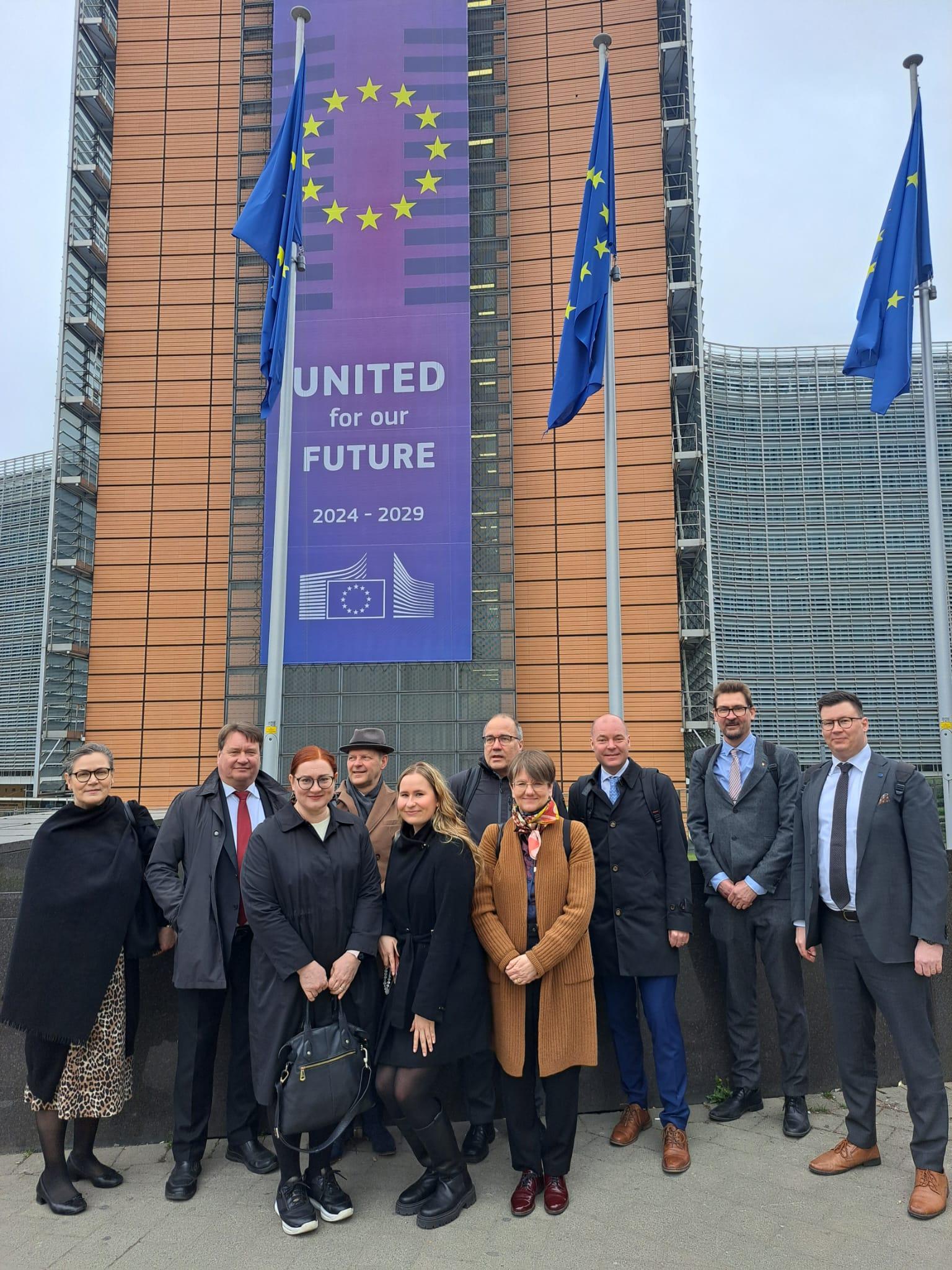
In the delegation picture from left Outi Rouru, Kari Aalto, Johanna Bluemink, Ari Alatossava, Anna-Sofia Heikkinen, Arto Maaninen, Anne Rännäli-Kontturi, Jussi Rämet, Claes Krüger and Markus Erkkilä. Picture Hanna Honkamäkilä. Preparations for the EU’s long-term budget for the years 2028–2034 are underway, and Oulu Region’s advocacy actors want to ensure that the needs of Northern Finland are taken into account from the very beginning. The current €1 200 billion multiannual financial framework is valid until 2027. This week, Region Mayor of the Oulu Region Jussi Rämet, Oulu Mayor Ari Alatossava and University of Oulu Rector Arto Maaninen visited Brussels for an intensive round of advocacy. Their schedule included meetings with, among others, the European Commission’s Directorate-General for Regional developement, Internal Market, Industry, Entrepreneurship and SMEs, Finnish Members of the European Parliament, and the cabinet of Commissioner Henna Virkkunen. “The Commission's goal is to make the budget simpler, more flexible, and more impactful. This is a commendable aim, but at the same time, we must ensure the regions retain their ability to influence. Cohesion policy is vital for Northern Finland – if Finland receives only single national funding package for cohesion and agriculture, we must ensure that the needs of Eastern and Northern Finland are addressed. The special status of Northern sparsely populated areas must be safeguarded so that all of Finland can develop in a balanced way”, Jussi Rämet emphasized. Northern Finland well-positioned to benefit from EU Competitiveness plans The new Commission’s political priorities include defence and security, sustainable prosperity, and social justice. In the Oulu region, particular attention is being paid to the Commission's proposed Competitiveness Compass, which focuses on innovation, the green transition, and security – all of which are key themes in region's EU advocacy. “EU funding is crucial for research, development and innovation. Developing wireless technology and…
Council of Oulu Region joined the Living-in.EU initiative
Council of Oulu Region joined the Living-in.EU initiative in an event organised during the European Week of Regions and Cities, #EWRC this week in Brussels. Living-in.EU 's goal is to promote sustainable digital change and give boost to digital transformation in EU regions and cities. Signing the commitment enables the Council of Oulu Region to participate in Living-in.eu's working groups. The Living-in.EU initiative was initiated in Oulu in 2019. Behind the initiative is the Eurocities cooperation network of the most significant European cities. The network was founded in 1986 and includes more than 200 cities. #EURegionsWeek [caption id="attachment_45643" align="alignnone" width="300"] Council of Oulu Region joined the Living-in.EU initiative during the European Week of Regions and Cities, #EWRC. The commitment was signed by Regional Mayor Jussi Rämet.[/caption]
Regions at the heart of the green transition
Region Norrbotten visited Council of Oulu Region on Monday and Tuesday. We hade joint meeting on current matters in Region Norrbotten and Oulu Region. We discussed especially about logistical cross-border connections, cohesion policy and industrial policy of the European Union. Starting international daily train traffic between Oulu and Haaparanta The electrification of the Laurila-Tornio-Haaparanta line will be completed at the turn of 2024–2025. The Council of Oulu region has proposed to the Finnish government that the 2025 budget should include funding to start international daily train traffic between Oulu and Haaparanta. 2.1 million euro should be allocated to the state budget to the purchase service contract of the Ministry of Transport and Communications from 2025. Opening passenger traffic across the border would enable the development of tourism, and the rail connection would also serve the Bothnian arc working area. European Capital of Culture year 2026 in Oulu and in the region would also greatly benefit for better train connection to Sweden. Northern Sparsely Populated Areas and cohesion policy The most important goal in EU cohesion policy is to preserve the special role for Northern Sparsely Populated Areas. In addition to the importance of traditional cohesion policy, new funding and implementation needs can also be identified in cohesion policy. The problem with fully utilizing the Recovery and Resilience Fund, RRF, is that it has been done at the expense of regions. RRF is centrally managed, and state led. Instead of national implementation, development should continue to be regional. Cohesion policy supports the EU's single market. The EU's internal market is a common market of 450 million consumers, where goods move freely. This represents 60% of Finland's exports go to the internal market area. The EU must also consider the situation of the EU's eastern border. The loss of cross-border funding should…
Events

Baltic Sea Tourism Forum 2026
The Baltic Sea Tourism Forum 2026 #BSTF2026 will take place in beautiful Helsingør (Elsinore), Denmark, with a networking programme on 2 November and the main Forum day on 3 [...]