11.03.2021
Growth from micro-enterprises and developing their operating conditions
Director
the Kerttu Saalasti Institute
Research, development and training activities aimed at micro-enterprises and their operating conditions are a necessary investment from the perspective of sustainable growth and development in Northern Ostrobothnia. There are 22.8 million micro-enterprises in the EU, representing 93.1% of the EU-28 business base and 29.4% of EU-28 jobs. Over the past ten years, micro-enterprises have produced almost one third of the net positive job change in the EU-28 (Eurostat 2021). In particular, by expanding two narrow areas, it is possible to strengthen the conditions for sustainable growth in micro-enterprises.
Micro-enterprises have export potential
In relation to neighbouring countries, there is room for growth, especially in the export of micro-enterprises. According to Eurostat, micro-enterprises in Finland produce only 3.9% of the total value of exports, compared to 14.6% in Sweden. By this measure, Finland is among the last in Europe. Information and effective measures are needed to catch up. Success in these measures is a prerequisite for strengthening and diversifying the economic structure of Northern Ostrobothnia and Finland as a whole.
Entrepreneurial culture is a prerequisite for sustainable growth
Business start-up activity is low. Young people's entrepreneurial intensities, which have grown in recent years, are not yet realised in business start-up figures. According to the World Bank, only 4.3 new companies per 1,000 people of working age are established in Finland every year, which is significantly low compared to the Nordic countries and Estonia. Entrepreneurial culture can be strengthened, for example, by investing in entrepreneurship education at all levels of education.
Which countries should you learn from in order to widen the narrow areas described above?
Europe's small developed economies are in many ways a particularly interesting point of reference. They are innovation-driven and export-dependent. There are no economies of scale such as Germany, France, China or the United States. They face many similar challenges as Finland. Among the developed countries classified by the IMF, these economies include those in cooperation in cooperation with a population of between half a million and 20 million.
Fstakeholders, processes and best practices that increase the export activity of micro-enterprises can be sought in countries where exports of micro-enterprises are high relative to population. These include Norway, the Netherlands, Sweden, Switzerland, Austria, Ireland, Slovenia and Estonia. Fstakeholders, processes and best practices that increase start-up activity can be found in countries in cooperation in cooperation with high start-up activity. These are Estonia (23.6 enterprises per 1000 working age population), Luxembourg (17.2), Denmark (10.1), Norway (8.6), Latvia (8.0) Sweden (7.2). Concrete examples can be used to bridge the gap between young people's entrepreneurial intentions and start-up activity.
In terms of export dynamics and start-up activity, some of the same countries emerge from the small advanced economies. Estonia, Sweden and Norway show an advantage in both reviews. On a European level, therefore, there is something very close to be learned. Crossing borders in neighbouring areas is more about attitude than costs. At the same time as we take stock of the best examples in the neighbourhood, we should not forget the examples of small developed economies outside Europe. New Zealand, Israel, Singapore and Puerto Rico offer interesting ‘out of the box’ thinking and new approaches.
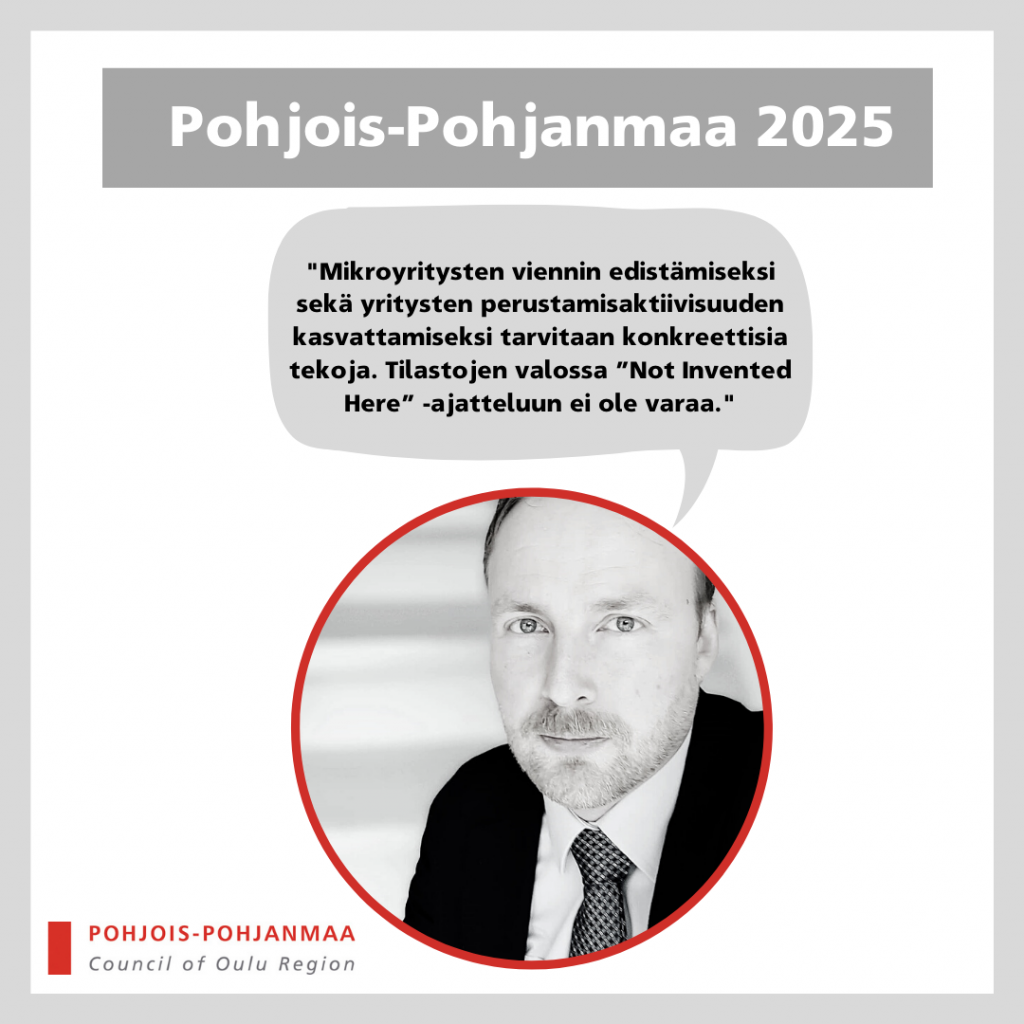
Concrete actions are needed to promote the export of micro-enterprises and to increase their start-up activity. The narrow areas described above are those for which solutions can be sought from the best comparator countries. In the light of statistics, ‘Not Invented Here’ cannot be afforded. The projects of the new programming period in European cooperation provide a platform for finding practical solutions to concrete problems. I'm signing up for this job!
Matti Muhos
Director
the Kerttu Saalasti Institute