17.03.2021
Nature – a source of well-being and Participation and Participation and Inclusion in Northern Ostrobothnia
Diaconia University of Applied Sciences Sokra subproject expert
There are no things in the village on the threshold
Northern Ostrobothnia pampers us in cooperation in cooperation with magnificent nature. It serves us seaside areas, coastal areas crossed by rivers, marshlands and highlands. The area of the region is about 25,500 km² of forest, and the area includes the national parks of Oulanka, Rokua and Syöte, as well as part of the Hossa National Park. The positive image is also confirmed by the 2017 Environmental Awareness Award, which was awarded to forests and peatlands in Northern Ostrobothnia, and the Rokua Geopark, Finland's first UNESCO Global Geopark.
We are beginning to understand how important nature is to the quality and even continuity of life. Proven well-being effects include: recovery, lowering stress levels, slowing down the pulse, lowering blood pressure, increasing the body's multifaceted microbiota, and various pleasure experiences. The good state of the environment thus creates a basis for the comfort of the living environment and the well-being of people.
The natural environment also seems to have an impact on inequality. It seems to be of greater benefit to the most vulnerable. For example, people in cooperation in cooperation with financial or work worries or crises seem to benefit most emotionally from mind-set visits. There are even indications that the differences in mortality rates between different socio-economic groups are smaller in the regions in cooperation in cooperation with the most nature.
Muds runned that dog is getting old
In Northern Ostrobothnia, too, people's health is threatened by various diseases and disorders. Challenges related to mental well-being and economic inequalities experienced by families in cooperation in cooperation with children are of particular concern. It is noteworthy that the longer the child has lived surrounded by green spaces before reaching the age of 10, the lower the risk of mental health problems. Another study found that the green environment appears to have positive effects on children's intelligence and behavior. Green areas and the natural environment also have a positive impact on people's social wellbeing: They make it possible to meet other people and increase social ties and sense of community.
When children's living environment can be Influencingd by increasing nature in such a way that they experience less anxiety or depression and more confidence and social Participation and Participation and Inclusion, it is good to take it into account in the design of the living environment. Also important from the point of view of safety is what came up in one study: the greener the residential environment, the lower the incidence of both property and violent crime.
It is important to look at people's well-being as a whole that interacts in cooperation in cooperation with the environment. The whole is Influencingd by many things, such as aesthetics, places of mind, safety, temperature, sound and attractiveness. It would certainly be easy to develop mapping applications where people could mark meaningful routes for movement and outdoor activities or share their own favourite places in the OpenStreetMaps style. Technological solutions can be used to make nature virtually accessible to those who cannot move around in nature. The well-being effects of nature are also transmitted through the window and in cooperation in cooperation with the help of pictures or video images.
Don't worry, fish will get wet
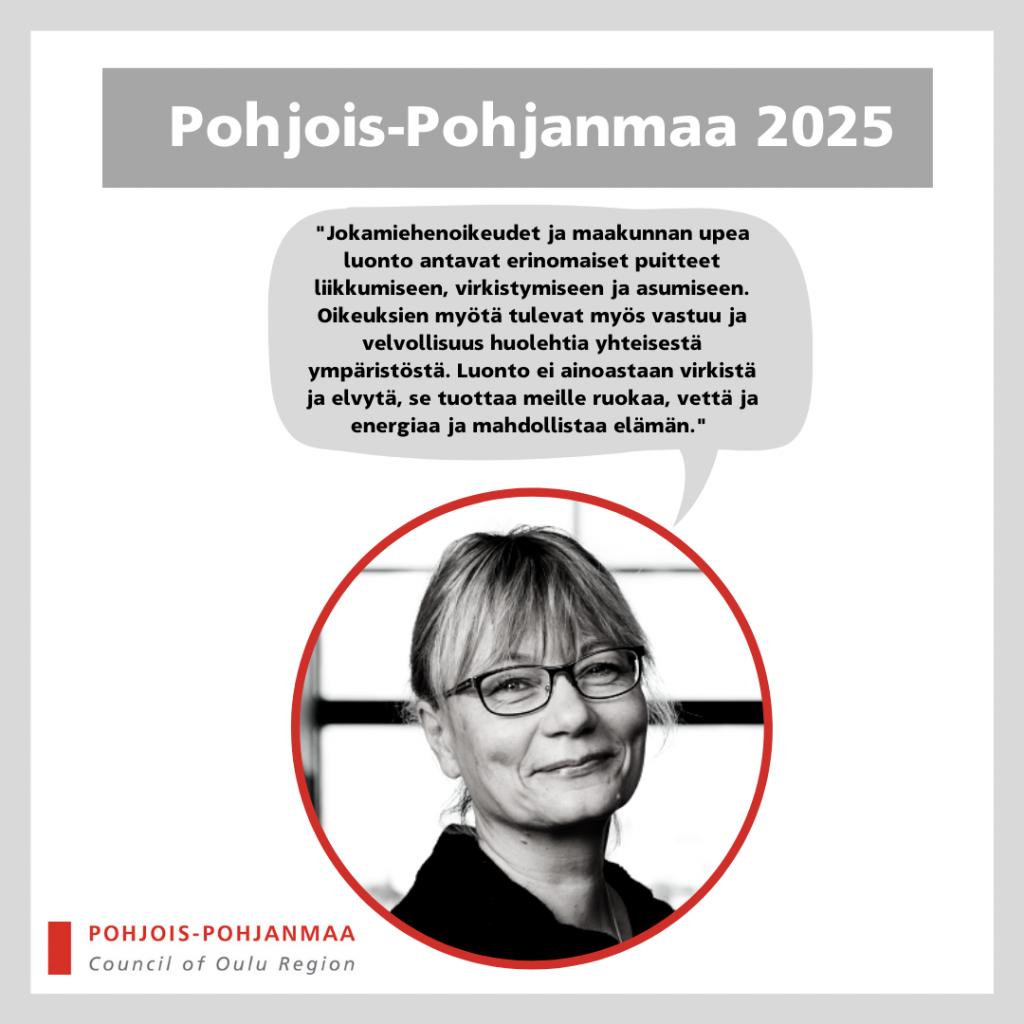
Everyman's rights and the magnificent nature of the county provide an excellent setting for movement, recreation and housing. in cooperation in cooperation with these rights comes the responsibility and responsibility to take care of the common environment. Nature not only refreshes and revives us, it provides us in cooperation in cooperation with food, water and energy and enables us to live.
Northern Ostrobothnia is characterised by a healthy living environment in which residents who feel involved live meaningful, manageable and understandable lives. It is therefore necessary to invest in both nature and human well-being, as enablers of sustainable growth and prosperity, also in the future.
Quoting the words of A.V. Koskimies, let this country inspire us – and bravely, honestly and unwaveringly take care of each other and nature.
It's better to have a good day ahead of you than behind you.
Varpu Wiens
Diaconia University of Applied Sciences Sokra subproject expert