22.03.2021
A Mystery Called Northern Ostrobothnia
Regional Development Consultancy MDI
From an outsider's point of view, Northern Ostrobothnia is a mystery. The area resembles soap, which is not easy to get hold of. The image of Northern Ostrobothnia from the outside does not convey either a positive or a negative point of view. When you hear the word Northern Ostrobothnia, most people think of Oulu, Kärpät, Lestadianism, the North, technology, engineers and Nokia.
Northern Ostrobothnia is often overshadowed by the great and powerful Oulu.
It comes as a surprise to most that Northern Ostrobothnia is the fourth largest concentration of residents, jobs and businesses in the country. Or that the region's level of education is the third highest after Uusimaa and Pirkanmaa. In the area, it is also possible to throw one trump card over others, i.e. future capital in the form of children and young people. The region is the number one in research, development and innovation spending, especially thanks to the continuous ability of Oulu universities and companies to renew themselves. More investment has been made in wind power than anywhere else in Finland. The quality of life, happiness and satisfaction in cooperation in cooperation with one's own life are among the highest in experiential surveys.
When you bring up places such as Kuusamo, Kalajoki, Ylivieska, Raahe, Rokua, Iso-Syöte, Hailuoto or even Raahe in the discussion, you make the listener wake up and get interested in the whole area in a different way. The first comment is often an open question about whether all those places are really in Northern Ostrobothnia. Few counties have urban pulses, Peatlandss, seas, sandy beaches, forests, lakes, wilderness and fells. The happiness of Northern Ostrobothnia is strong in Oulu and its higher education decision-making bodies, but the rest of the area is also colourful and multifaceted.
Northern Ostrobothnia is among the top six regions in terms of vitality or growth, well above the average. However, not everything is at the forefront of interregional competition, and there is a lot to develop. The main pain points in the region are related to relatively modest regional economic and employment dynamics, high morbidity and internal segregation.
In my opinion, the biggest challenges of the 20s and 30s in Northern Ostrobothnia are related to traction and grip power. For decades, the Oulu urban area has absorbed the flows of young people and experts from a wide range of Influencings. In the future, flows from traditional regions of origin will become thEnabler. Oulu is also not attractive and attractive in terms of migration flows across the country, unlike other large growth centres. The employment of recent graduates in their own area is at most reasonable. The brain drain of trained people to the Helsinki metropolitan area and Tampere region has accelerated in recent years.
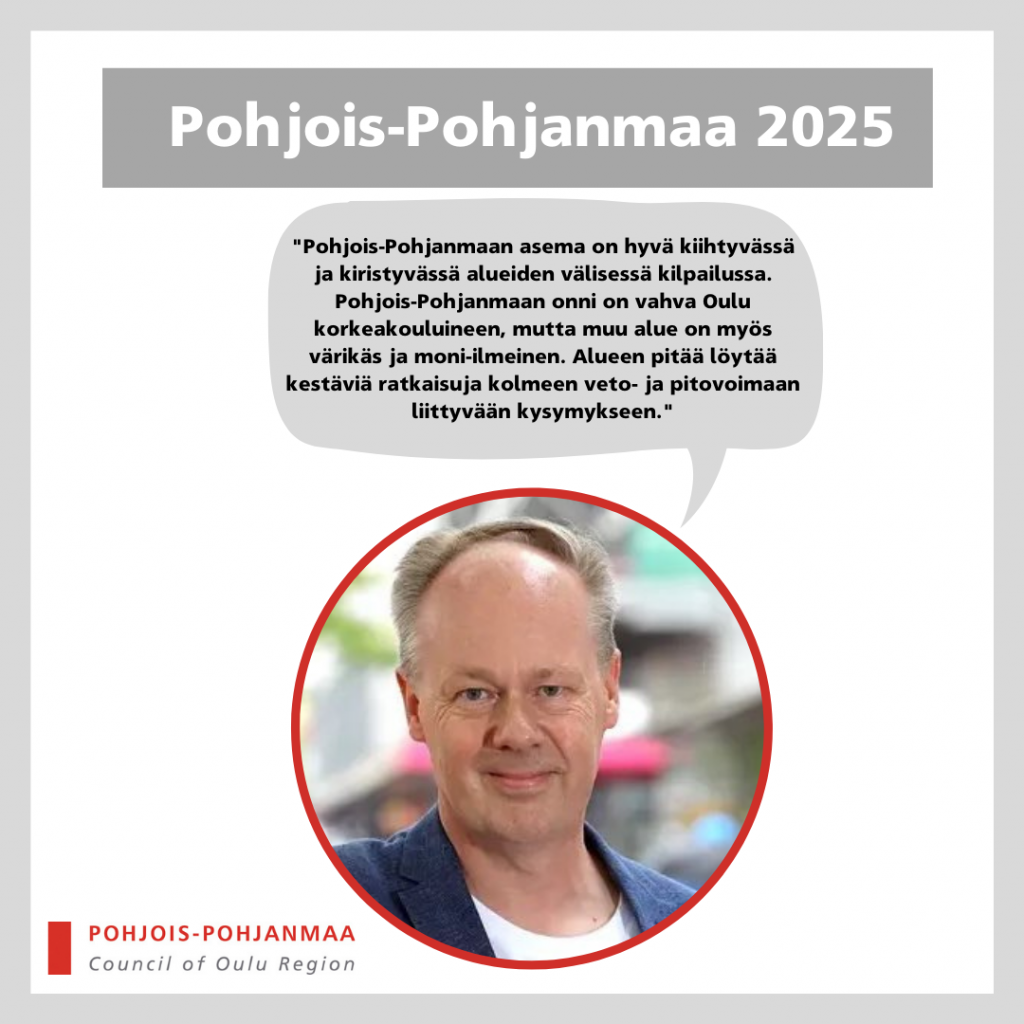
The region needs to find sustainable solutions to three issues related to traction and traction.
- A higher proportion of recent graduates, especially those who have been trained, must be allowed to remain in the region.
- We must dare to invest more in international migration based on education and skills. The entire region must be able to raise the level of ambition related to internationalisation in all its activities.
- The mental and reputational images associated in cooperation in cooperation with the area must be translated into a more open, tolerant and fun way by one's own actions. in cooperation in cooperation with regard to the latter question, Oulu's becoming the Capital of Culture would open up a huge potential multiplier.
Despite the challenges, Northern Ostrobothnia's position is good in accelerating and intensifying competition between the regions. The keys to success are still in your hands. Around the Bay of Bothnia, billions of investments in the Arch of Bothnia create a great momentum also in Northern Ostrobothnia. And most importantly, the region's DNA has the ability to thrive and regenerate. Every structural change in different eras has opened up new opportunities. Thanks to creative destruction, the region has accumulated a huge amount of RDI and know-how capital. In addition, the region's strengths include strong business networks, larger entrepreneurs, venture capital and the courage to act as a forerunner.
One thing is certain: Success does not depend on the lack of a Northern Ostrobothnian attitude.
Timo Aro, Regional Researcher
Regional Development Consultancy MDI