20.08.2024
Regions at the heart of green industrial change
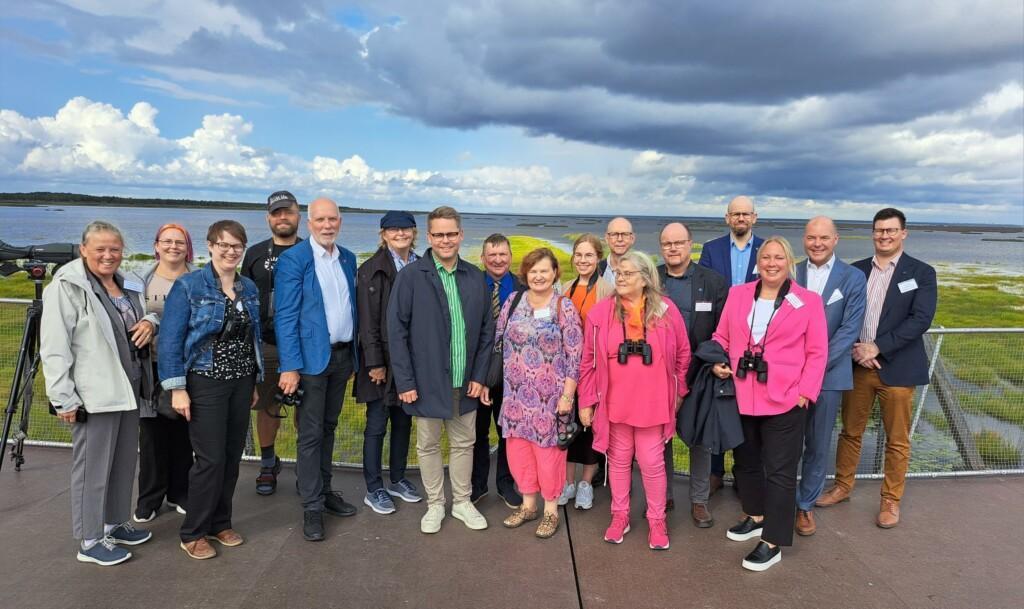
Region Norrbotten visited the Regional Assembly of Oulu Region on Monday and Tuesday. We held a joint meeting on topical issues in Norrbotten and Northern Ostrobothnia.
In particular, we discussed logistical cross-border links, cohesion policy and the industrial policy of the European Union.
Start of international daily train traffic between Oulu and Haparanda
The electrification of the Laurila-Tornio-Haaparanta railway will be completed at the turn of 2024-2025.
The Regional Assembly of Oulu Region has proposed to the Finnish Government that funding be included in the 2025 budget to enable international daily train traffic between Oulu and Haparanda. The purchase agreement of the Ministry of Transport and Communications should be allocated EUR 2.1 million to the state budget as of 2025.
Opening up passenger traffic across the border would enable the development of tourism, and the rail connection would also serve the working area of the Bothnian Arc.
The European Capital of Culture 2026 in Oulu and the region would also greatly benefit from a better train connection to Sweden.
Northern Sparsely Populated Areas (NSPA)s and cohesion policy
The main objective of EU cohesion policy is to maintain the special status of Northern Sparsely Populated Areas (NSPA)s.
In addition to the traditional cohesion policy, it can also identify new financing and implementation needs. The problem in cooperation in cooperation with the full use of the EU Recovery Instrument (RRF) is that it has been done at the expense of the regions. The RRF is centrally controlled and state-run. Instead of nationwide implementation, development activities must continue to be area-based.
Cohesion policy supports the EU's internal market. The EU single market is a single market for 450 million consumers, where goods move freely. 60 % Finland's exports are directed to the internal market area.
The EU must take into account the situation at the EU's external border in the East. The loss of cross-border funding in Eastern Finland must be compensated in some way.
Increased cooperation between Norrbotten and the Regional Assembly of Oulu Region in EU industrial policy
Joint proposals for EU funding for industrial development emerged. These include the regional hydrogen valleys of the Bothnian Arc, the extraction and enrichment of critical minerals, and wireless technology.
Both regions have significant heavy industries, such as SSAB. Both regions are already suffering from labour shortages.
Socio-economic impacts of the green transition in Norbotten
The region of Norrbotten has published a report entitled ‘Social and economic impact on the green transition’. The main message of the report was that the region's new industrialization will increase national GDP by 2-3 %, between EUR 1.5 billion and EUR 3.5 billion in tax revenue and EUR 10 billion in export value. It creates new jobs and significantly reduces CO2 emissions.
The impact on the regional economy is enormous, but there is also a great need for new housing and infrastructure. The industrialisation of the green transition also implies a strong increase in energy demand.
During the summer, the Swedish government announced its own strategy for Northern Sweden. It contains many development proposals.
Link the Report on the Industrial Transformation of Norrbotten and its Socio-Economic Impacts.
Strategi för nyindustrialiseringen och samhällsomvandling i Norrbottens och Västerbottens län