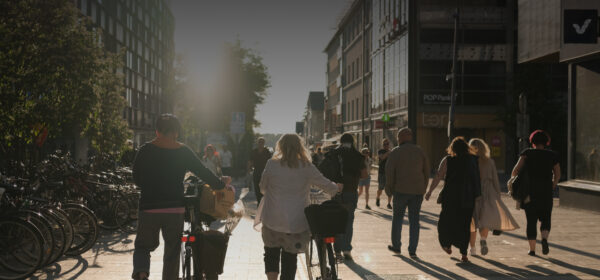
Figure: Sanna Krook / City of Oulu
In Northern Ostrobothnia, sustainable growth is based on development that takes into account ecological, regional economic, social and cultural impacts. At the same time, climate change mitigation and adaptation, securing carbon sinks, and taking care of biodiversity, the good condition of water bodies and green environments are taken into account. The region is determined to move towards carbon neutrality, based on knowledge and cooperation.
Why a smart bio- and circular economy?
- Policy instruments, legislation, targets and, above all, market-driven demand support production based on renewable bio-based raw materials. → Renewable and innovative RDI know-how is needed.
- Provides an opportunity to take advantage of the available funding channels. → Various projects and groups.
- The strengths of Northern Ostrobothnia include abundant biomass reserves, clean soil, water and the benefits of Arctic production, as well as functional transport connections. → harnessing agriculture, forests and peatlands for carbon sequestration and improving and developing the ecological status and multiple use of water bodies.
- The expertise of the region creates opportunities for the success of Northern Ostrobothnia also as a provider of global solutions. → New investments in the region and access to international markets are needed.
- The bioeconomy benefits the region in a variety of ways. → The production and processing of renewable natural resources can offer a new, profitable business.
- The region has several circular economy-based ecosystems under development. → These opportunities, as drivers of sustainable growth, must be broadly supported.
Impact of mobility and land use
Efficient land use, low-emission mobility, the prerequisites for the bio- and circular economy and renewable energy production are at the core of mitigating and adapting to climate change, securing carbon sinks and creating a diverse green environment. The planning and construction of land use must be prepared for increasing extreme weather events and other changes and risks caused by climate change. Land use solutions also create the conditions for low-emission mobility, in the development of which cooperation between different sectors and the coordination of different measures are emphasised. Means of low-emission mobility include sustainably selected means of transport, sustainable mobility infrastructure and services, and renewable fuels.
Green energy production!
- Currently, Northern Ostrobothnia is Finland's leading producer of wind power and produces nearly 40 of Finland's wind power %.
- Wind power production is growing rapidly and continuously.
- Offshore wind provides a lot of additional potential.
- Peat in energy production is reduced through a socially just transition and replaced mainly by wood.
- Investing in fossil-free steel production would reduce Finland's greenhouse gas emissions by seven per cent.
- Potential nuclear power projects would reduce greenhouse gas emissions from electricity production.
- The production of biogas offers a strong agricultural region new opportunities both for the regional economy and for reducing greenhouse gas emissions.
- The region is developing fossil-free energy production and storage, smart energy systems and energy efficiency, future forms of energy and solutions to the challenges posed by the transformation of the energy economy.
Sustainable agriculture
Northern Ostrobothnia is a nationally significant agricultural region. However, agriculture accounts for 30 of the region's emissions. %, so its development from the perspective of sustainability and climate change is key. Responsible food production covers the entire value chain. Agriculture plays an essential role in mitigating climate change by sequestering carbon, which can be achieved through renewal and innovation. The ways in which agriculture in the region is reformed include strengthening soil carbon sinks and carbon farming, making peatland farming activities the most environmentally friendly, promoting resource efficiency in agriculture, securing food production and increasing profitability, and smart food production.
What do we do in practice to achieve our goals?
Key projects for sustainable growth:
- Regional plan for the energy and climate phase
- Implementation of the Climate Roadmap 2021-2030
- Energy transition and climate impact assessment in the regional plan -project
- Developing new forms of energy for cities and municipalities
- Pyhäjärvi energy storage project and the reuse of Pyhäsalmi mining infrastructure to serve the energy transition
- Haapavesi biorefinery project
- Promoting a zero-emission steel industry