TUULI project: New opportunities for wind power construction in Northern Ostrobothnia
17.6., updated 4.8.2022
The studies of the TUULI project have been completed: location control model identifies potential wind power areas
The goal of the TUULI project of the Regional Assembly of Oulu Region is to promote sustainable wind power construction in Northern Ostrobothnia. As a result of the TUULI project, the wind power potential of Northern Ostrobothnia can be presented, as well as a regional view of the most suitable areas for wind power construction. The preparatory studies for the TUULI project (green structure and ecosystem service study, updating study of the main migration route of birds, wolf territory study and electricity transmission study) were completed in December 2021 and the location control model was completed in early June 2022. The project's vision work will continue until the end of August 2022.
The location management model of the TUULI project has identified new areas suitable for wind power construction and identified potential future wind power areas. As a result of the spatial data analysis, 250 areas were created, 12 of which are located in the marine area and 238 on land. All 250 regions from the spatial data review proceeded to further review. The areas were examined taking into account environmental, social and techno-economic perspectives. These included the impacts related to the activities of the Defence Forces, feedback from municipalities and cities on the areas, comments received in the stakeholder consultation of the reindeer herding municipalities on areas important for reindeer husbandry, and features related to the electricity transmission network and capacity, soil, fairway and road network. As a result of the follow-up review, the regions were divided as follows: 31 'yes' areas suitable for wind power, 136 'may' areas and 85 'no' areas. Non-areas are not presented as wind power areas in further planning.
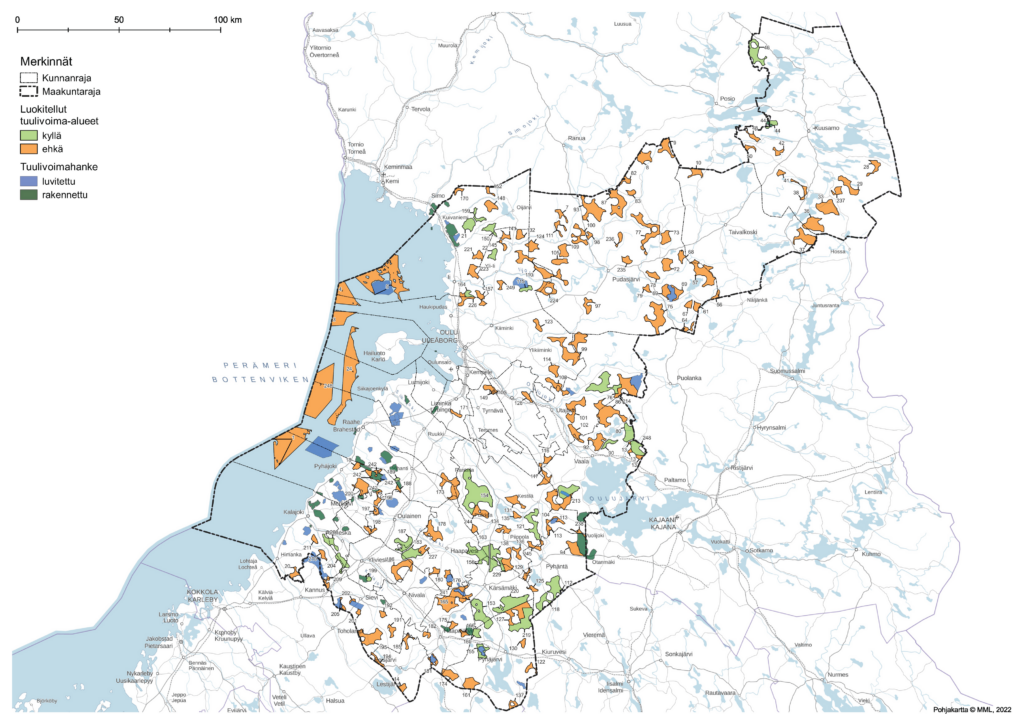
Figure: Yes and maybe areas in accordance in cooperation in cooperation with the location control model of the TUULI project, as well as completed and licensed wind farms.
A target card has been drawn up for each yes and maybe area, presenting basic information about the area, urban structure, electricity transmission and roads, natural environment, landscape and cultural environment, synergy effects and attention to further planning.
The objective of the location control model is to map new wind power areas, so the areas for which a wind power park has been implemented were excluded from the areas that have been highlighted. In addition, the areas for which a wind power master plan has been drawn up and the power plants have already been granted building permits were excluded.
From the location control model to the regional plan for the energy and climate phase
The results and background studies of the TUULI project are an important part of the renewal of the regional plan, which, for example, updates the regionally significant wind power areas (TV areas) of the 1st and 3rd phase regional plan and identifies new areas suitable for wind power. The boundaries of the potential wind power areas identified in the location control model will be specified in the regional plan and later in possible more detailed planning in the wind power master plans and the EIA procedure. In the ongoing draft of the regional plan for the energy and climate phase of Northern Ostrobothnia, the most potential areas according to the location control model are selected. The draft regional plan for the energy and climate phase of Northern Ostrobothnia was discussed at the meeting of the Regional Board on 21 June 2022 and will be available for viewing in August 2022. A landscape study, an eagle habitat model study, a special transport/trafficability study and an assessment of the combined effects of wind power areas are also prepared for the proposal phase of the Regional Land Use Plan. The aim is to proceed in cooperation in cooperation with the approval process in the course of 2023.
In April 2022, a total of 412 power plants in cooperation in cooperation with a total capacity of 1597 MW were built in Northern Ostrobothnia. There are approximately 2930 MW of licensed wind power in the region. More than 6,000 MW of additional capacity is planned for the ongoing wind power plans. Based on the results of the electricity transmission survey of the TUULI project, the ongoing projects can mainly be connected to an existing or planned electricity network.
The expert consultant in the project is Sweco Infra & Rail Oy, subcontracted by Rejlers Finland Oy and William Velmala tmi. The project is funded by the Centre for Economic Development, Transport and the Environment of Northern Ostrobothnia/the European European European European European Regional Development Fund (ERDF) (ERDF) (ERDF) (ERDF) (ERDF), the member municipalities of Northern Ostrobothnia and the Regional Assembly of Oulu Region. The total cost of the project is EUR 392 136. The project will run from 1 August 2020 to 31 December 2022.
More information about the TUULI project:
Erika Kylmänen, Environmental Manager, Regional Assembly of Oulu Region, tel. +358 40 685 4041, erika.kylmänen(at)pohjois-pohjanmaa.fi and
Sari Pulkka, Project Coordinator of the TUULI project, Regional Assembly of Oulu Region, tel. +358 40 685 4037, sari.pulkka(at)pohjois-pohjanmaa.fi.
On the TUULI project's website and story map, you can learn more about the material of the TUULI project's location management model and the results of background studies, as well as the situational picture of wind power construction.
Story map of the TUULI project
Figure: Yes and maybe areas in accordance in cooperation in cooperation with the location control model of the TUULI project, as well as completed and licensed wind farms (Pohjois-Pohjanmaa Regional Assembly, Sweco 2022).