05.06.2025
Livojoki's migration juvenile production is evaluated
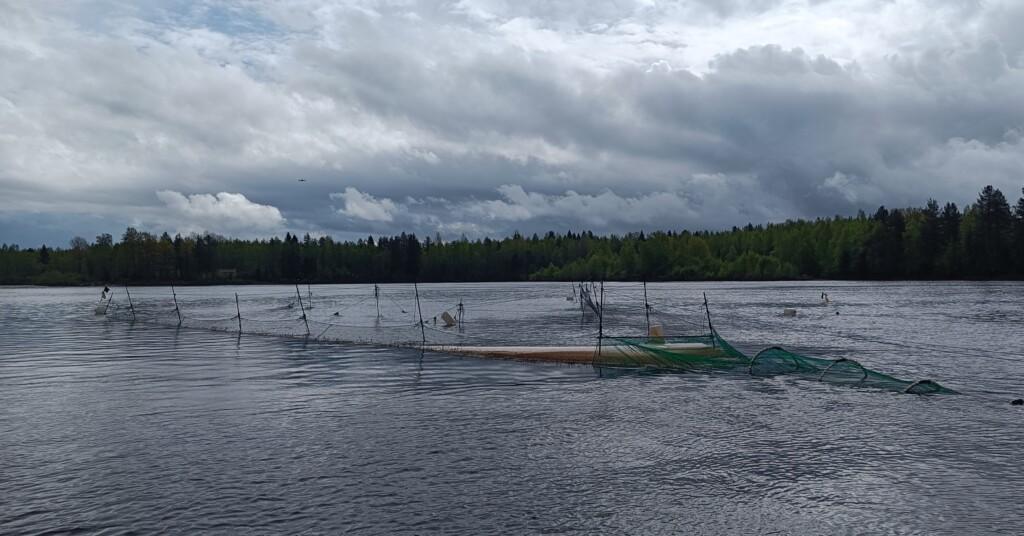
The migration juvenile production of salmon and sea trout in Livojoki (Iijoki tributary) will be assessed using trap hunting and marking-back hunting of juveniles in 2025 and 2026. Individual data are stored on migratory juveniles (smols) caught in traps and the fish are marked. Trap hunting and marking of fish in Livojoki take place in May-June and monitoring in Haapakoski downhill migration route in Iijoki takes place in May-July.
‘The fish shall be identified by external streamer characters. The mark will be removed from the fish in cooperation in cooperation within a few weeks and will not cause harm to the fish. The fish marked in the tagging-back hunt are taken back upstream and released. Marked fish re-entering the trap make it possible to estimate the catching efficiency of the trap and the total number of migratory juveniles still leaving the Livo river’, says Natural Resources Institute Finland's Specialist Ville Little.
In addition, the study examines how quickly smolts marked in the Livojoki research trap migrate to Haapakoski in Iijoki and how much of them can be caught in cooperation in cooperation with the Haapakoski downhill migration channel's catching device. In addition to the smolts caught in the Livojoki river, the study also uses smolt implants, some of which are marked in cooperation in cooperation with PIT microchips.
Project manager for the Lohi Iijoki 2 project Mirko Laakkonen The Regional Assembly of Oulu Region is pleased in cooperation in cooperation with the situation: “The investigation has started promisingly. 270 smolts have been marked on the Livojoki river, and 61 of them have so far been caught on the Haapakoski downhill migration route. A total of 5553 smolts have been caught in Haapakoski so far.’
The research is part of the Lohi Iijoki 2 project and it is carried out in cooperation between the Regional Assembly of Oulu Region and the Natural Resources Institute Finland. Korpilaavu Oy is responsible for practical work in Livojoki and Haapakoski, Iijoki. Other measures of the Lohi Iijoki 2 project include underwater camera monitoring of smolts in Haapakoski, the development of the downward migration route of smolts in Haapakoski, over-transfers of fish and smolts, and the restocking of small juveniles.
The Lohi Iijoki 2 project is implemented by PVO-Vesivoima Oy, the Lapland ELY Centre, the Ministry of Agriculture and Forestry, Ii, Oulu, Pudasjärvi, Taivalkoski, Kuusamo, the Regional Assembly of Oulu Region, the Iijoki fishing area, Metsähallitus, the Northern Ostrobothnia ELY Centre and the Natural Resources Institute Finland. The project is managed by the Regional Assembly of Oulu Region. The project will be implemented from 9 January 2024 to 31 October 2026. In addition, the Natural Resources Institute Finland participates in smolt monitoring studies in cooperation in cooperation with separate project funding from the Ministry of Agriculture and Forestry.
The Lohi Iijoki 2 project has received funding from the NOUSU programme of the Ministry of Agriculture and Forestry. The programme improves the living conditions of migratory fish and aims to restore the natural reproduction of migratory fish stocks in Finland's current waters.
Additional information:
Mirko Laakkonen, Project Manager, Lohi Iijoki 2 project, Regional Assembly of Oulu Region, tel. +358 40 685 4036, mirko.laakkonen(at)pohjois-pohjanmaa.fi
Ville Vähä, Senior Specialist, Natural Resources Institute Finland, tel. 029 532 7878, ville.vaha(at)luke.fi