19.02.2025
OECD researchers analysed and put challenges, opportunities and recommendations for sparsely populated areas in Eastern and Northern Finland, Sweden and Norway into a research report
The Organisation for Economic Development and Cooperation (OECD) has completed a major research project launched in autumn 2022. A study called Supporting the implementation capacity for sustainable green development in Europe’s Arctic northern sparsely populated areas or officially: Support to the implementation capacity of sustainable green development in the European Arctic Northern Sparsely Populated Areas (NSPA) was published on Tuesday 18 February 2025 in Brussels. The final folded report will be available in mid-March.
The group of European northern sparsely populated areas covered by the study comprises Eastern and Northern Finland, Northern Sweden and Northern Norway, i.e. a total of 14 counties. The project was commissioned and funded by the European Commission's Directorate-General for Structural Reform Support (DG Reform).
The study is based on statistical analyses, surveys and interviews in cooperation in cooperation with people representing the stakeholders' organisations in the area. As a result of the work, a number of thematic and regional reports have been completed, both for the entire NSPA region, Eastern and Northern Finland and for the regions of each region. The reports include not only analyses of key themes for regions such as competitiveness, sustainable green development and demographics, but also recommendations for necessary policy measures.. The success of the region and its regions requires a holistic approach combining competitiveness, sustainable development, accessibility and participatory governance. All parts of this puzzle need to be aligned, otherwise bottlenecks will arise that prevent the desired development.
For Eastern and Northern Finland, population decline and ageing is a trend that affects the availability of labour and the dependency ratio. Promoting international migration and attracting young people are critical measures in this context. The region's research and development activities are now focused on higher education decision-making bodies, and the main development focus is on supporting and strengthening the innovation activities of SMEs.
The recommendations for our region are similar: support for innovation in SMEs, support for entrepreneurs, measures related to the labour market situation and the promotion of clean energy solutions, international trade measures are among the most important measures needed by the region on the OECD list. The list of recommendations also includes the development of logistical connections and infrastructure.
in cooperation in cooperation with regard to the big picture, the findings of the OECD are largely familiar to the stakeholders in the region. In this respect, the study mainly provides confirmation of belief that the situational picture is in the possession of the region. The external review also reveals things that we ourselves have not necessarily noted or, on the other hand, things that we take for granted. For example, the OECD sees significant potential for cooperation and economic integration in cooperation in cooperation within the NSPA area, which is hampered by the lack of physical and digital infrastructure. The study thus provides strong support for the development of, for example, east-west cross-links. In addition, a separate study was carried out for all regions for the whole part of the study. In other words, we have received recommendations at the European, national and regional levels.
Summary of comments on Northern Ostrobothnia
– Strengthening innovation and high-tech sectors. Investing in R&D and innovation ecosystems, in particular in the areas of ICT, health technologies and the green economy, by providing incentives for public-private partnerships and promoting cooperation between universities, research decision-making bodies and industries in order to maintain and enhance the region’s competitive edge in high-tech innovation. There is also a need to focus on supporting start-ups in accessing research and innovation support.
– Increased support for SMEs and entrepreneurs. Develop targeted support programmes for SMEs and entrepreneurs focusing on access to finance, mentoring and market expansion opportunities. Encourage growth from micro-enterprises to small and medium-sized enterprises, especially in sectors identified as smart specialisation and in cooperation in cooperation with high growth potential, such as health technologies and battery technologies.
– Promoting labour market dynamics and development of skills and competences, in particular for older workers. Implement development of skills and competences and lifelong learning programmes in line in cooperation in cooperation with market needs, in particular in emerging sectors and for older workers, who are increasingly active following recent pension reforms. This includes improving VET and higher education curricula to address existing skills shortages and prepare the workforce for future industry demands.
– Promoting sustainable development and the green transition. Take advantage of the region’s commitment to environmental sustainability by supporting the transition to a green economy. Investing in renewable energy projects, sustainable transport and circular economy practices, as well as climate change mitigation initiatives.
– Improve international trade and export support. Enhance the region's export capacity by providing targeted support to companies wishing to expand into international markets. This includes providing market information, trade facilitation services and logistical support to take advantage of Northern Ostrobothnia's strategic position and export infrastructure.
– Investing in digital infrastructure and services. Continue to develop and expand digital infrastructure and ensure high-speed internet access throughout the region, including in rural areas. Promote digital literacy and the uptake of digital technologies by businesses and the public sector to improve competitiveness and service delivery.
– Tackling demographic challenges through migration and integration policies. Develop comprehensive migration and integration policies that attract and retain talent and take into account labour needs and demographic changes. This includes simplifying the immigration process for skilled workers and providing support for integration into local communities.
Improve accessibility and infrastructure development. Invest in critical infrastructure, including transport, logistics and public services, to improve connectivity in cooperation in cooperation within the region and to external markets. Prioritise sustainable and innovative infrastructure projects that contribute to economic growth and environmental objectives.
– Ensure equitable access to social services. Improve access to quality health, education and social services across the region and focus on reducing disparities between urban and rural areas. Invest in modernising the provision of public services through technology and innovation.
– Promote internationalisation and attractiveness. Set Northern Ostrobothnia as an attractive place to live, work and invest. This includes promoting the region's quality of life, cultural assets and economic opportunities internationally, as well as policies aimed at improving the region's international links and partnerships.
Condensed challenges, opportunities and recommendations for Northern Ostrobothnia
- Challenges: Demographic challenges, especially in rural areas, bottlenecks in transport connections.
- Opportunities: Oulu's technology and research ecosystem is strong.
- Recommendations: Attract young people and migrants, support the start-up ecosystem, increase infrastructure investments.
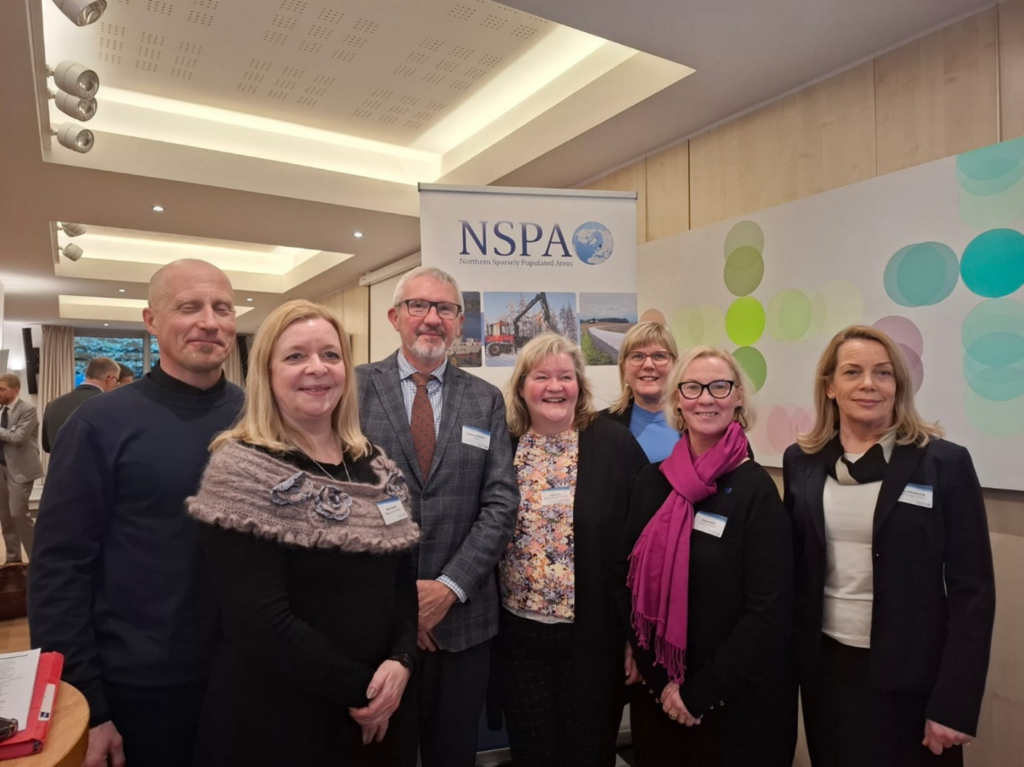
NSPA regional development directors from the left Jouni Ponnikas, Päivi Ekdahl, Eira Varis, Merja Olenius, Tiina Rajala and Satu Vehreävesa together in cooperation in cooperation with Senior Policy Analyst, OECD, Stefano Barbieri, who is third from the left.