02.10.2024
Photographic exhibition on swimming in the Oulujoki river basin on 30 September – 30 October, this time in Kajaani
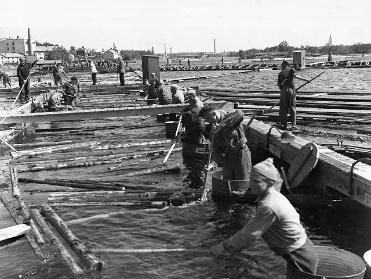
Invented the use of Hartaanselkä separation in Oulu in 1947 Photographer: Mauno Mannelin
One year ago in Oulu, the exhibition "The journey of wood from the top waters to the world - Mauno Mannelin's photographs of Kainuu and Northern Ostrobothnia" is now available in Kajaani's main library. Industrial photographer Mauno Mannelin photographed the harvesting and sowing of wood in the Oulujoki river basin since the late 1940s, for example, at the request of the Oulujoki Uittoyhdistys. The exhibition photos tell about the conditions under which wood was cut, transported, sorted, bundled and loaded onto ships. There are also pictures of wood processing factories and ports.
At the beginning of his career in the 1930s, Mauno Mannelin portrayed industry and commerce in the magazine of the Association for Finnish Work. In the 1950s, he specialized in photographing forests, forest work, swimming and the forest industry. Technical improvements or new equipment were often selected for photography, which is reflected in the exhibition.
In the Oulujoki river basin, wood was bathed for over 100 years: The Senate confirmed the ferrying rule for the river basin in 1879, and the fishing in the Oulujoki River ended in 1982 and in the Ontojoki River in 1984.
The sawmill and paper machine of Kajaani Puutavara Osakeyhtiö, founded in 1907, and the steam sawmills of Korkeasaari, Pateniemi, Varjakka and Toppila, owned by Ab Ulea Oy, founded in 1912, were important users of swamped roundwood. Later large users of roundwood were the Pateniemi sawmill, which was founded in 1936 by Oulu Osakeyhtiö, the Nuottasaari mills completed in 1937, the Pateniemi wooden house factory, which operated from 1940 to 54, and the Osakeyhtiö Puuseppä Oy and Hyrynsalmi sawmill, which were acquired in the 1950s. In the Oulujoki river basin, trees were also floated to the Toppila sulphite cellulose mill and wood mill, to the Martinniemi mills of Rauma-Repola Oy and to A. Santaholma Osakeyhtiö's sawmills in Kalajoki, Raahe and Haukipudas.
In the 1920s and 30s, relatively little attention was paid to work to improve floating conditions, such as the construction of floating dams, the cleaning and straightening of fairways and the construction of fixed floating equipment. It was not until the late 1930s, and especially after the Second World War, that it was found that the rehabilitation of the fairways was a good way of curbing the wage costs of the swimming pool.
At first, the floating dams were temporary Santa dams, but gradually these more durable log coffin dams for continuous use were also built. In 1935, there were only half a dozen permanent dams on the common paths. In 1960, there were more than 40 usable floating dams on the routes of the Oulujoki Uittoyhdistys association, of which 16 are concrete dams. The exhibition includes a picture of a swimming dam in Kuusamo.
Prior to World War II, demolition efforts to promote floating were minimal. Efficient and large-scale cleaning in the Oulujoki river basin began in 1950, when Väylänrakennus Oy acquired the country's first track-laying tractor exclusively intended for clearing fairways. By 1960, almost all the rapid sections and power bays on the top and side lanes of the floating association's area of operation had been gutted. At the same time, minor fairway adjustments had been made and lake caverns hampering the transport of ferries had been spread. On the main waterways, on the other hand, the cleaning work was limited, as the rapids had already been altered due to tarboat traffic and some of the rapids were falling under the dams of power plants.
Until 1939, there was so-called loosening in the entire river basin. In the river sections of the fairways, the trees swam with the stream loosely, but in the lakes they were transported in large circular rafts. In the beginning, the ferries were transported by horse or male grouts, but from the 1930s onwards by mechanical power.At Oulujärvi, which was connected to the communal area in 1933, the bunkering of logs was moved to 1939. The log bundling machines were ordered from Kajaani Telakka Oy and already in the same year most of the timber going from Kajaani and Kiehima to Vaala was towed in bundle boards over Lake Oulujärvi. For the manufacture of wood pulp, the so-called stacker bundling machines were introduced with the separation of Kajaani in the summer of 1944 and Kiehämä in 1951.
Ways of ignoring the difficult Kajaani River had been sought already in the 1930s. The completion of the Koivukoski power plant in 1943 and the upcoming regulation of Oulujärvi tightened the decision to build a transmission line across a five-kilometre-wide stalk from Kuluntalahti in Rehjajärvi to Jormuanlahti in Oulujärvi. Thus, since 1953, all the trees to be floated from the Kuhmo route to Oulu, as well as a small part of the logs going to Kajaani, were transported in bundles via the transfer track.
Another important project in the 1950s was the construction of the Merikoski bundling plant. When the Merikoski power plant was completed, it became apparent that after the third turbine had been completed, the sorting and bundling of trees in Hartaanselkä would become more difficult due to too high a flow. It was decided to transfer the separation of Oulu to Madekoski and a Valmet crane was built in connection with the Merikoski power plant. The solution was completely new in our country when it comes to overtaking the power plant and unique in the world when it comes to the crane type. Since 1958, all the trees floated from the Oulujoki waterway to Oulu were moved in bundles past the Merikoski power plant. The bundle transfer equipment of other Oulujoki power plants was built in 1960-64.
The photo exhibition will be on display at Kajaani Main Library from 30 September to 30 October 2024. The exhibition is organised by the Association of Finnish Local and Regional Authorities in cooperation with the Regional Council of Northern Ostrobothnia and the Regional Council of Kainuu. The exhibition is part of the European Day of Cultural Environments.
Sources:
Ahhhhhhhhhhhhhhhhhhhhhhhhhhhhhhhhh 2017. Oulujoki river basin power plant architecture - Preliminary study on World Heritage values. Humanpolis Oy
Ontojoki Village Association website History - Ontojoki Village Association (yhdistysavain.fi) (read on 16/09/2024)
Purhonen, Elias, 1960. Oulujoki Swimming Association 1910-1960 – Briefing on the 50th anniversary of the commonwealth. Oulujoki Uittoyhdistys.