Generic selectors
Exact matches only
Search in title
Search in content
Post Type Selectors
Search in posts
Search in pages

news

16.11.2026

Baltic Sea Tourism Forum brings together tourism operators from the Baltic Sea region in Helsinki
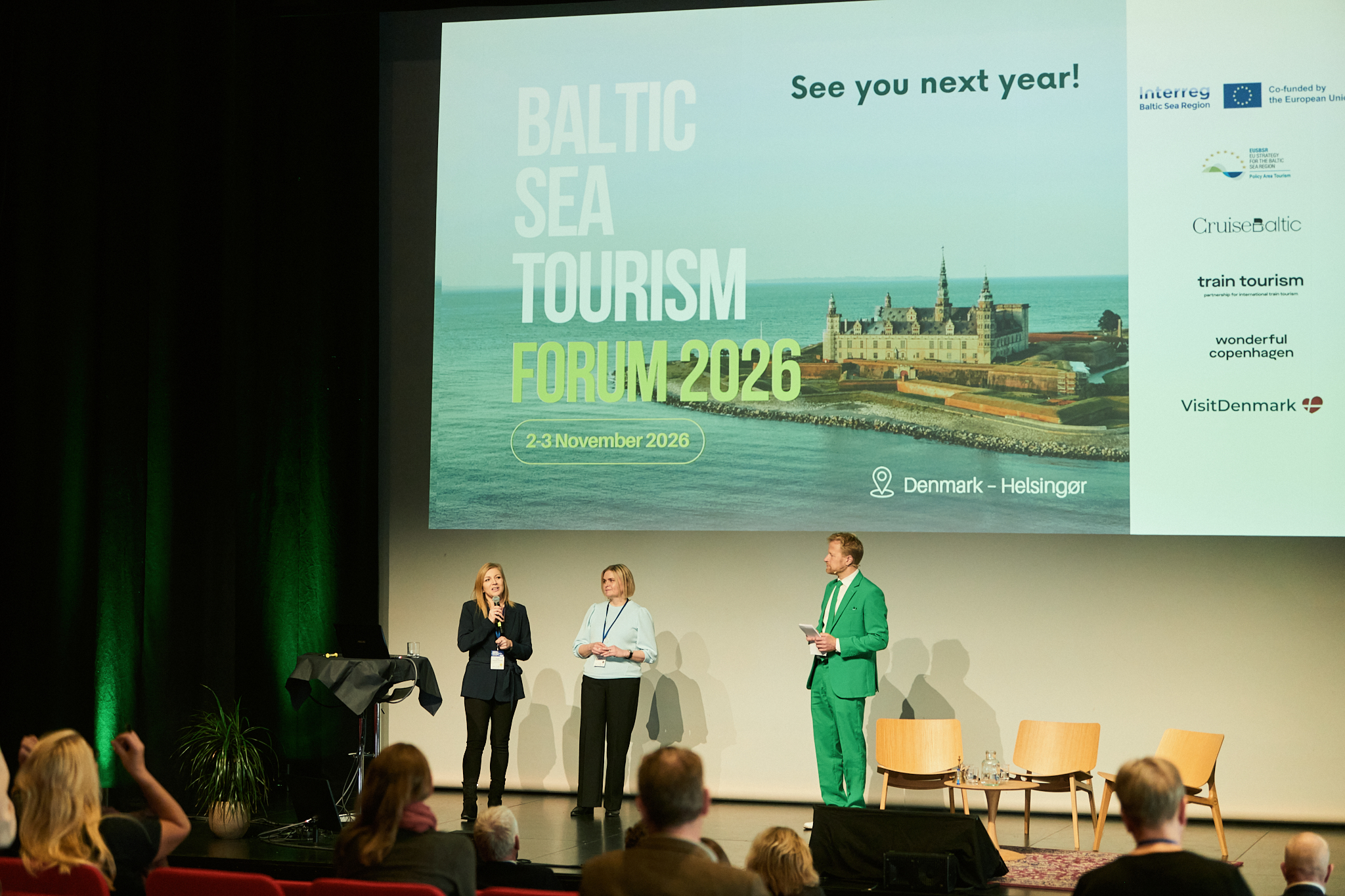
PA Tourism coordinators Magda Leszczyna-Rzucidło and Anna-Maija Toivonen and host of the Baltic Sea Tourism Forum at Aslak Gottlieb Helsingör. Photo: Emil Hornstrup Jakobsen / Fotoemil.nu

Since 2022, the Regional Council of Northern Ostrobothnia has been the coordinator of the EU Strategy for the Baltic Sea Region (EUSBSR) Policy Area Tourism together with the Polish Pomorskie Tourist Board. One of the most visible annual events of the cooperation is the Baltic Sea Tourism Forum, which brings together tourism organisations, regions, companies, experts and other tourism operators from all over the Baltic Sea region.

The Baltic Sea Tourism Forum 2026 took place on 2-3 November in Helsinki, Denmark, bringing together 136 participants from the Baltic Sea region. This year, discussions focused on promoting more sustainable choices for tourists, developing cross-border rail travel, spreading the benefits of cruise tourism beyond major port cities and the future of tourism.

From Sustainable Goals to Practical Choices

One of the key issues of the platform was how to make sustainability goals visible in the real choices and behaviour of tourists. Copenhagen's CopenPay was one practical example of this. In the model, tourists are encouraged, among other things, to cycle, use the train and engage in activities that benefit the environment by offering different experiences and benefits in return.

In Skåne, tourists are guided to explore less congested destinations and find new ways to experience the area. Tallinn's example showed how local food, experiences, resource efficiency and cooperation with companies can combine sustainability with local economic benefits.

New network for cooperation between climate-smart tourist destinations

The forum launched the Baltic Sea Region Climate Smart Destinations Network, where regional tourism organisations work together to develop more climate-smarter tourism. The participants already include Pomorskie, Helsinki, Tampere, Aarhus, Tallinn, Kaunas and Stavanger.

The network's operations will start in February with a joint remote meeting, so now is a good time to join in. Regional tourism organisations in Northern Ostrobothnia are also welcome to join the network to learn, share experiences and build new cooperation opportunities in the Baltic Sea region..

Get to know the network and join us.

Better connectivity and tourism benefits for the whole region

Cross-border mobility was one of the key themes of the Forum. Making international rail travel a truly functional option requires cooperation between tourism regions, transport operators and other actors across national borders.

Cruise tourism was also examined especially from the point of view of smaller ports and tourist destinations. The discussions focused on local food, nature, culture and genuine encounters, as well as on how the benefits of tourism can be shared more widely with local businesses and communities.

The aim is therefore not only to increase the number of visitors, but also to create more local value from tourism, while taking into account the carrying capacity and characteristics of the sites.

The number of visitors to future tourism alone will not solve

The final part of the Forum focused on the future and how the success of tourism should be measured.

One of the key messages of the discussions was that the number of tourists alone is not enough to measure success. Tourism should strengthen local communities and businesses, support the vitality of regions and make places attractive to both visitors and residents.
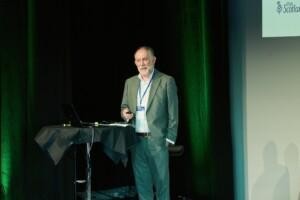
Ken Massie, Head of Destination Development / Visit Scotland. Photo: Emil Hornstrup Jakobsen / Fotoemil.nu

Ken Massie from VisitScotland summarized the idea in his presentation:

“The places that thrive tomorrow will not be the places with the most visitors. They will be the places where visitors help create a better future.’

The idea combined Helsingör's discussions well: the future competitiveness of tourism does not just mean a larger number of tourists, but that tourism generates more value for regions and local communities.

Cooperation at the heart of the Baltic Sea Tourism Forum

The Baltic Sea Tourism Forum once again showed how important it is to bring together expertise from different countries and industries. Challenges such as sustainable mobility, climate change and balanced tourism development cannot be solved by individual tourist destinations.

The Forum and the cooperation on tourism in the EU Strategy for the Baltic Sea Region also attracted interest in the Danish tourism media. In the margins of the event, Magda Leszczyna-Rzucidło, the Polish coordinator of Policy Area Tourism, discussed the platform and cooperation on tourism in the Baltic Sea region with Gry Koefoed, the journalist of the Tourism Monitor. Read the Tourist Monitor article.

BSTF 2026 was organised in the framework of the EU Strategy for the Baltic Sea Region, Policy Area Tourism, together with Wonderful Copenhagen, Cruise Baltic, Port of Helsingør, Partnership for International Train Tourism and VisitDenmark. The event was co-financed by the Interreg Baltic Sea Region programme and co-organiser partners.

At the same time, the key message of the forum sums up the work of Policy Area Tourism: we bring actors together, build connections and strive to turn cooperation into concrete action throughout the Baltic Sea region.

See Baltic Sea Tourism Forum 2026 presentations and event photos on the Policy Area Tourism website.

Related articles

09.09.2026
Ingredients for growth visible – labour demand has not revived

Recent economic data do not come as a big surprise. The turnover of industries continues to grow steadily, but the number of employees has not started to increase. In several clusters, such as ICT, the number of employees is on a downward trend. Only in the metal cluster has the labour force increased moderately. Recruitment is increasingly affected by general uncertainty and technological developments. However, the growth in turnover in the industries is so strong that employment is likely to improve. The big question is when and where is it going to happen? However, excessive credit for the long-term positive impact of major projects on labour demand may be unrealistic. The situation of the ICT cluster, which is important for Oulu, is challenging. Revenue is increasing, but personnel is in a relatively strong decline. The ICT cluster has been characterized by strong monthly turnover fluctuations, in April the growth from the previous year was 12.1 per cent, but in May came down by 5.9 per cent. The impact of AI can be seen in the demand for the cluster's workforce, at least indirectly. Companies closely monitor the development and deployment of AI and anticipate the need for workforce in relation to it. The trump card of the future is 6G mobile technology, the developer of which Oulu plays a key role globally. Construction has been active for several semesters. From 2025, net sales increased by 2.3 per cent and the number of employees decreased by the same amount. Residential construction is still quiet, but some new projects have started. The growth in net sales has come from the construction of industry, tourism and the public sector. Oulu hotel projects and later data centers will significantly increase construction. In the case of data centres, the key issue is how much local companies have access to it, and what is the capacity of the area's earthworks The electricity and energy cluster and the metal cluster are growing strongly. The growth of both from 2025 is in the order of 10%. In the metal cluster, the number of employees has also increased. Net sales growth has been more moderate in wholesale and retail trade and tourism, where the number of personnel has been decreasing. The year-on-year change in the wood and furniture industry was as much as 13.8 per cent and there was also an increase in the number of personnel. In all clusters, seasonality is high, especially in construction. In digital services, Finland's service sector is less developed than in the peer countries, which is also visible in Northern Ostrobothnia. The use of services is still difficult for many in our culture. Jobs in trade and services are important, especially for young people. The growth of many industries also depends on the development of digital services,…

28.08.2026
Sign up for the Northern Ostrobothnia Tourism Forum 2026!

Wednesday 14.10.2026 from 9.00 to 15.00 Venue: Hotel Lasaretti, Aurora Hall, Kasarmintie 13 B, Oulu Registration for the Northern Ostrobothnia Tourism Forum 2026 The most important tourism seminar in Northern Ostrobothnia will be held again in October - sign up! The event brings together tourism companies, developers and decision-makers to hear and discuss current topics and future opportunities in the field. This year's themes are the permanent impact of the title year on the region, the importance of events for tourism, and the role of artificial intelligence and responsibility in the sustainable and competitive development of tourism. Programme 8.00 Morning coffee and registration 9.00 Introduction to the event 9.05 Opening remarks Kristiina Hietasaari, Senior Director, Visit Finland 9.30 Keynote - Heritage of the European Capital of Culture Year Suvi Innilä, Turku 800 Project Director, City of Turku Innilä has served as Project Manager and Programme Director for the European Capital of Culture year 2011 and as Programme Manager for the centenary of Finland's independence. 9.50 Commentary and discussion 10.30 Break 10.50 Development of events in Kuusamo Niina Kukka, event manager, Ruka-Kuusamo Tourism Regional Assembly 11.05 Building a successful event, the significance of international tourism and the year of the Capital of Culture Oulu, Syöte and Kalajoki 11.45 Lunch, self-sufficient 13.00 Investments and accessibility development accelerated by the Year of Culture Oulu Chamber of Commerce and BusinessOulu 13.30 Artificial intelligence is changing tourism: What is worth doing now? Ville Niemijärvi, Artificial Intelligence Specialist, Senior Consultant, Flowhouse 14.00 Comment: YT Anderson, Visit Northern Finland 14.10 The situation and future of tourism funding Saija Tikkanen, Specialist in International Affairs, Regional Assembly of Oulu Region Pasi Loukasmäki, Head of Finance Unit, Vitality Centre 14.30 Oulu2026 End of the Capital of Culture year highlights Samu Forsblom, Programme Director, Oulu Cultural Foundation 14.45 Visit Northern Finland Current and closing words Y.T. Anderson, CEO, Visit Northern Finland Oy 15.00 Changes to the programme are possible. We will complete the speeches during the autumn. The event will be held at Hotel Lasaret in Oulu, but you can also participate remotely via stream. For the participants of the event, an accommodation quota is reserved from the hotel for a special price156 €/night/2hh. Reservations for rooms from the quota for 13-15 October must be made by 14 September at the latest using the reservation code "42402 Business Oulu 13.-15.10.2026". Reservations directly to the hotel by phone or e-mail: tel. +358 20 757 4701, lasaretti@lasaretti.com. Due to the limited capacity of the facilities, student groups are welcomed to follow the event via stream. Welcome to network, inspire and develop tourism together! The event is organized by BusinessOulu, Oulu Chamber of Commerce, Visit Northern Finland Oy and Northern Ostrobothnia…

04.11.2020
Strategy work on tourism in Northern Ostrobothnia is ongoing

The strategy work for tourism in Northern Ostrobothnia is underway, and the views of stakeholders in the field have been surveyed to support the work. The survey was conducted in October. The survey was aimed at tourism entrepreneurs, tourism developers, representatives of tourism Regional Assemblys and educational decision-making bodies, and authorities supporting tourism. The response rate of the survey was 47 per cent. %, and 47 responses were received. In particular, the number of open comments in the survey was gratifyingly high. Thank you to all the respondents! We are currently reviewing the results of the survey, and the results will be used to determine the priorities of the tourism development strategy in Northern Ostrobothnia. The themes highlighted in the survey include digitalisation of tourism, cooperation between tourism stakeholders and raising awareness of the region. Further information: Heikki Ojala, Development Manager, tel. +358 (0)50 433 3951 or e-mail.