19.03.2021
Blog: Has anything changed in tourism?
In early 2020, tourism attracted both domestic and foreign visitors. Many forums had noted that tourism is a significant part of our economy, both at the national level and at the level of many municipalities. In the spring, tourism had to take a sudden stop, from full speed to zero in the middle of the heaviest season.
Since spring 2020, we have been a virtually closed tourist area for international tourists. We anticipated the all-time domestic tourism summer, which it also was for many regions. The development between the regions was surprisingly different. Overnight stays registered in Northern Ostrobothnia in June-September 2020 were up (+2.9 %), e.g. in Lapland (-20,4 %) and Central Finland (-27.3 %) was not as successful. There were great differences in cooperation in cooperation within our region. Kalajoki (+8.1 %) and Kuusamo (+27.4 %They showed their attraction. Objects known for nature and activities in nature pulled the longest straw. We searched for places where the space was well above the minimum safety distances. The summer was a real summer cottage, which is not reflected in Statistics Finland's figures, because the cottages are not included in their statistics. For many, last summer was the first time we went on holiday from the south further away from Central Finland. We got a large number of first-timers excited about our destinations. The guests were delighted and surprised that there are such wonderful places and nice things to do in Finland! How will this interest lead to holiday trips to our county in the future, when competition in cooperation in cooperation with palm boulevards, Berlin cafés and Tallinn's Old Town opens?
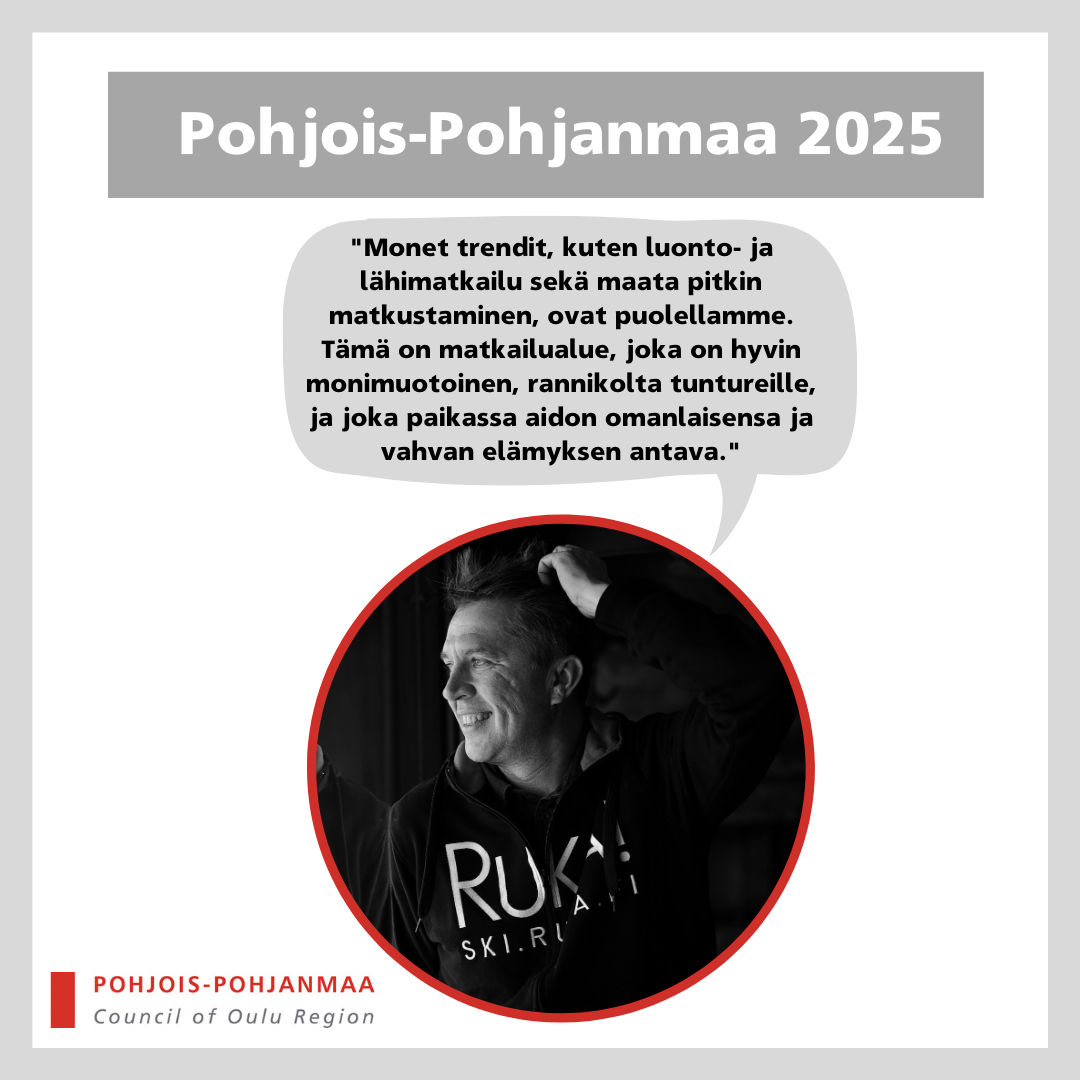
Many trends, such as nature and local travel, as well as traveling by land, are on our side. But in cooperation in cooperation without strong regional measures to increase our attractiveness, we will not be able to cope in cooperation in cooperation with domestic customers choosing their destination. The same goes for international customers. Nature, space to move around and great experiences are our assets, but too few international tourists or tour stakeholders know Northern Ostrobothnia.
in cooperation in cooperation without considering whether we are still living in the midst of a serious health crisis or a ‘new normal’, many things have changed in our daily lives. The digital leap that we prepared for as individuals and as a livelihood in cooperation in cooperation with trembling steps suddenly turned into a real leap. Remote working became the new normal. New tools and forums had to be adopted immediately. Digitalization can be utilized, for example, by means of virtual tourism, which has been a topic of much interest lately. Virtual tourism supports our tourism industry when we use it in marketing or guidance. If a significant part of the travel experience were to become digital, we would quickly remain underdogs in relation to the gaming industry or the big digital giants. The best souvenirs are created from real experiences, which are produced by the magnificent nature and real encounters in cooperation in cooperation with people.
At this time, responsibility is one of the most important fstakeholders determining the success of tourism. Health and safety is the most important thing. Responsibility more broadly, including responsibility for the environment, economy and culture, has gained a boost through the coronavirus crisis. Consumers and service providers are becoming increasingly aware and everyone is required to act more responsibly. In the future, responsibility will not be a marketing asset, but a basic requirement for being involved in the game.
Serious crises are best dealt in cooperation in cooperation with together. The result is strong when a large group of people commits to doing things and combines their resources in cooperation in cooperation with a joint effort. The same applies to other major challenges, not just crises. When you want to achieve significant change, such as success in the industry, the best strategy is to set big goals together.
After the ambitious target setting, we need to have sufficient resources for the measures, the sum of which is not only good, but even the most rapidly growing tourism region. A tourist area that is very diverse, from the coast to the fells, and that gives a genuinely unique and strong experience everywhere.
The change we make ourselves is better than the change we have to react to afterwards. If our business environment changed, we are lagging behind, but when we change it ourselves, we are in the locomotive!
Mats Lindfors
CEO of Ruka-Kuusamo Tourism Regional Assembly
The article is part of the blog series of the Regional Programme for Northern Ostrobothnia - views and insights on development.