The twelfth application period for projects (ERDF) of the Regional Council of Northern Ostrobothnia for the 2021-2027 programming period ended on 30 September 2026. During the application period, 78 new applications were received by the Regional Council of Northern Ostrobothnia. The applications applied for funding from the Regional Council of Northern Ostrobothnia totalling approximately EUR 13,966 million. Decisions on applications for positive follow-up will be delivered in November 2026. The next application period for new ERDF projects will run from June to September 2027. The funding to be applied for at that time is estimated at EUR 3,000,000. In addition, the application period for JTF projects will be implemented in early February-March 2027. Approximately EUR 2.500.000 in JTF funding is being applied for. The timetables and contents of the application periods will be specified after the granting powers have been confirmed in early 2027.
The Regional Assembly will discuss artificial intelligence, the future and what is true in social media The Regional Assembly of Northern Ostrobothnia will gather decision-makers, experts and influencers from the region to the Oulu Theatre on 2-3 November. In two days, the focus will be on technological change and its effects: artificial intelligence, the future and media literacy and culture. Monday's theme is Artificial Intelligence and the future. The keynote speaker of the day is technology influencer and Silo AI co-founder Tero Ojanperä. Together with Inka Mero, Ojanperä has written the book Radical Solutions - Seven Bold Acts for Finland, published in 2026. During the day, artificial intelligence will also be examined from the perspectives of science, computing infrastructure and ethics. These topics will be discussed by Minister of Science and Culture Mari-Leena Talvitie, Director of LUMI AI Factory Pekka Manninen and Ethics of Artificial Intelligence.
Statement of the Regional Governors of Eastern and Northern Finland 29.9.2026 Prime Minister Petteri Orpo has today strongly expressed Finland's concern that EU funding will continue to secure special funding for the northern sparsely populated areas of Finland (NSPA). This must be part of Finland's key objectives for the next EU funding period 2028-34. NSPA funding increases the amount of EU funding received by Finland as a whole and is a critical factor for the special circumstances of Eastern and Northern Finland, and it is not excluded from other EU funding received by Finland or increases Finland's EU payments. NSPA funding increases the amount of EU funding for Finland as a whole, the yield with which we can compensate for regional, economic and social differences. This EU cohesion policy aims to reduce regional disparities and strengthen European competitiveness. When Finland and Sweden joined the EU, it was recognised that the...
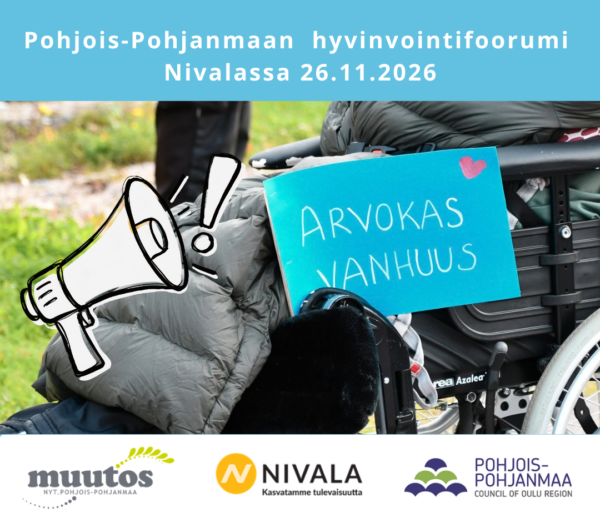
Change Now – Ageing well for everyone! The Northern Ostrobothnia Wellbeing Forum 2026 will be held on Thursday 26 November 2026 from 10 am to 2.30 pm at Champion Door Arena in Nivala, Kalliontie 59, 85500 Nivala. The Regional Council of Northern Ostrobothnia organises the forum in cooperation with the City of Nivala. The event is free of charge, including coffee and lunch. A free joint transport from Oulu to the event will be arranged. The North Ostrobothnia Welfare Forum will now be held for the nineteenth time. This year we will focus on the well-being of the elderly. The forum also hears about local good practices and rewards the well-being act of the year. The program has been published. You can register here by 16.11.2026.
Are you preparing a project application for the Regional Council of Northern Ostrobothnia's Municipalities implementing the green transition application (ERDF)? Are there any challenges in the structure of the application, in the measures considered or, for example, in considering the results of a lump-sum project that you would like guidance on? Or has it been a while since the last project was prepared? The Regional Council of Northern Ostrobothnia organises project sparring for applicants and opportunities to present projects in October. The purpose of the project clinics is to support the preparation of the project "Municipalities as implementers of the green transition". Two types of project preparation support are available: project sparring and project presentation. Participating in a project sparring or presentation does not guarantee a positive progress in the subsequent evaluation of applications. 1. PROJECTS - Monday 5.10. and Friday 16.10. Project sparring on the 5th of October focuses on projects that are still looking in their direction. This could be, for example, a reflection on the objectives and outputs of a lump-sum project,…
Oulu2026 has made art and culture a visible part of the everyday life of North Ostrobothnians. As the autumn progresses, the focus will also be on how to continue the activity and interest generated by the Year of Culture in the coming years. One way to continue working in the field of culture is the National Cultural Bank. It brings together art and culture professionals and their commissioned services in one place. – With the Oulu2026 year, the pulse of culture has increased in our region. The Cultural Bank of Finland is a good tool to maintain the heart rate in the future. The easy findability of cultural and artistic creators and ready-made services is an important part of this, says Samu Forsblom, Programme Director at the Oulu Cultural Foundation. From the Cultural Bank, an event organiser, company, municipality, school, association or private person can find, for example, a performer for an event, a workshop for a school or…
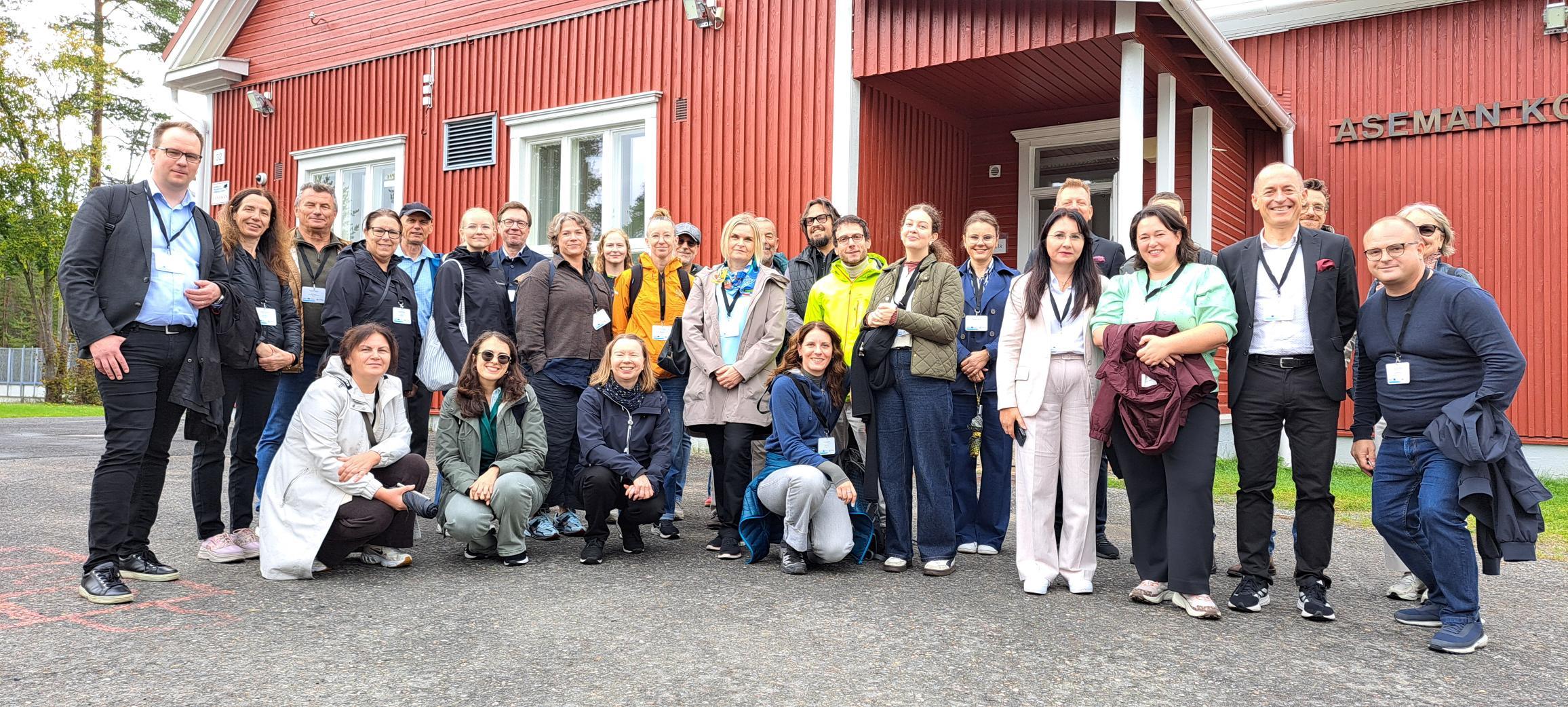
Figure: In early September, Rural COOP partners and stakeholders gathered in Oulu and Ii for the project's first international study visit to learn about good practices in sustainable rural development, climate work and the circular economy. On 2-3 September 2026, the Regional Council of Northern Ostrobothnia hosted the first international study visit of the Interreg Europe-funded Rural COOP project in Oulu and Ii. During the two days, project partners and regional stakeholders from across Europe learned about good practices in sustainable rural development, climate work, the circular economy and regional cooperation, and exchanged experiences on the future of regional development. The Rural COOP project develops the sustainable territorial development of rural and mountainous areas through foresight, inclusion and cooperation approaches. Study visits are a key part of the project's peer learning, the aim of which is to find new solutions for the development of regional policy measures. Partners with …
Sustainable growth, regenerative investments, tourism and security are emphasised in cross-regional projects that advance towards funding programmes in Eastern and Northern Finland. The implementation of the Eastern and Northern Finland programmes is progressing through ten large-scale projects. The projects will strengthen the regions' vitality, investment capacity, tourism, food chain, overall safety, as well as research, testing and piloting activities. The available IP AKKE allocation of just under EUR 16 million will be fully allocated to projects that have been successful in the evaluation of the first selection period. 33 applications were submitted for the first selection period for a total amount of more than EUR 52 million. The project steering group assessed the applications and processed them on 18 August 2026, selecting ten projects with which the Association of South Karelia will continue the financing negotiations. As a result of the selections, the appropriation will be allocated to the projects of the first selection period, and the search will thus be …
Pojois-Pohjanmaa | Regional Assembly of Oulu region
Recent economic data do not come as a big surprise. The turnover of industries continues to grow steadily, but the number of employees has not started to increase. In several clusters, such as ICT, the number of employees is on a downward trend. Only in the metal cluster has the labour force increased moderately. Recruitment is increasingly affected by general uncertainty and technological developments. However, the growth in turnover in the industries is so strong that employment is likely to improve. The big question is when and where is it going to happen? However, excessive credit for the long-term positive impact of major projects on labour demand may be unrealistic. The situation of the ICT cluster, which is important for Oulu, is challenging. Revenue is increasing, but personnel is in a relatively strong decline. The ICT cluster has been characterized by strong monthly turnover fluctuations, in April the growth from the previous year was 12.1 per cent,…
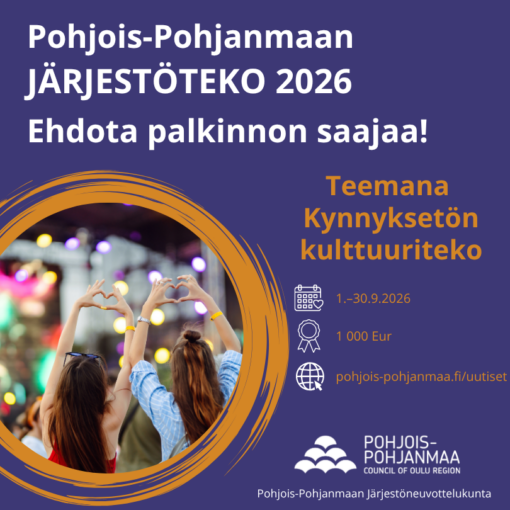
The Regional Council of Northern Ostrobothnia requests proposals for the organisation work of Northern Ostrobothnia in 2026. Proposals can be submitted between 1 and 30 September 2026. This year's theme is Unlimited Culture. An organizational act does not have to be an isolated act; it can be understood and interpreted more broadly. In the selection of the organizational act of the year, the emphasis is on the crossing of borders and impact, as well as the role of volunteering in the association's operations. The applicant must be a registered local association. The association that won the organizational act of the year will receive 1,000 euros to support its activities. The decision on the organisation of the year is made by the Regional Government of Northern Ostrobothnia. The proposals for the organizational work of the year will be made by 30.9.2026 at 15.00 using the electronic Webropol form. The organisation act of the year 2026 will be announced at the Regional Parliament of Northern Ostrobothnia on 3 November 2026. The prize is now awarded for the eighth time. The message can be shared freely in your own organization…