At its second meeting in 2021, the Regional Assembly of Oulu Region examined the reformed structural fund programme and various funding options, as well as the ongoing regional programme work. The Regional Assembly of Youth Societies of Northern Ostrobothnia was presented. “The only way for organisations to succeed in the future is through closer cooperation, which can be used, for example, in project activities. Among the forms of funding, ESF funding, for example, is a tremendously great and big opportunity for organisations.” This is how Secretary General Arja Sutela summarised the discussion about the different funding options currently available from the Youth Friends Regional Assembly and the new structural fund programme under preparation. Riitta Ilola, Finance Manager at the Centre for Economic Development, Transport and the Environment of Northern Ostrobothnia, was opening the meeting to discuss the state of preparation and draft content of the new and competent Finland 2021-2027 programme. The implementation of the programme will start in the autumn of this year. Organisations are encouraged to play an active role in the implementation of projects. In particular, the ESF, as a form of funding, is well suited to the activities of organisations. Also …
Pojois-Pohjanmaa | Regional Assembly of Oulu region
Northern Ostrobothnia strengthens its position as an ICT region The industrial sectors in Northern Ostrobothnia recovered well towards the end of the year. The uncertainty of the summer turned to strong growth especially in the ICT cluster, the wood products industry and perhaps surprisingly also in the metal cluster. Correspondingly, the net sales of construction, which had been growing for a long time, started to fall clearly, while the decrease in the number of personnel levelled off. The decline in construction is not due to seasonal fluctuations, but to weakening cyclical conditions. The services-intensive sectors have been hit hardest by the coronavirus, which is reflected in the development of the tourism workforce. Although domestic tourism recovered rapidly, demand for services has not started to rise. The strong growth in the number of staff in the private welfare cluster has also come to a halt. The creative economy cluster recovered well from the summer's grounding. In Northern Ostrobothnia, the cluster is closely linked to industry and construction, not so much to the event and art industries that have suffered from the coronavirus…
Pojois-Pohjanmaa | Regional Assembly of Oulu region
The call for applications from the European European European Regional Development Fund (ERDF) (ERDF) (ERDF) for projects under the REACT-EU programme amendment ended on 19 April 2021 in the Regional Assembly of Oulu Region. By the deadline, 53 applications were received by the Regional Assembly of Oulu Region. 23 applications were received for specific objective 12.1 Strengthening SMEs, in particular from the perspective of digitalisation and the green economy, and 30 for specific objective 12.2. Development of research and innovation activities, especially from the point of view of promoting digitalisation and achieving the goal of carbon neutrality in society. The applications applied for funding from the Regional Assembly of Northern Ostrobothnia for a total of EUR 19 084 767. The funding available for projects is approximately EUR 7.2 million.
Immobility costs money. At the Finnish level, the price of inactivity is estimated from 3.2 billion euros to as much as 7.5 billion euros per year in a study conducted by the Director of the UKK Institute Tommi Vasankari. A comparison can be made, for example, in cooperation with the acquisition of fighter jets by the Finnish Defence Forces, which is the most expensive acquisition in the history of the Finnish state. The price is estimated to be between $7 and $10 billion. The fighters are renewed approximately every 30 years, but the cost of immobility is annual. The majority of the costs of inactivity are currently borne by the adult population, the working age population. However, various studies show that the movement of children and adolescents has also decreased and overweight has increased. According to the same study, lack of mobility costs nearly 400 million euros per year in Northern Ostrobothnia. Measured by a different morbidity index, Northern Ostrobothnia is one of the most ill regions…
The situation in North America is interesting. In many places, the area is strongly growing, while in other places it is strongly shrinking. We are far from other growth centres and the capital, where accessibility is a particular issue for the development of our region. As values change and in the face of Finland's emission reductions, we need environmentally sustainable ways to travel to both the rest of Finland and Europe. The Helsinki-Oulu route is the most popular domestic flight in Finland. By speeding up the main line, you could get to Helsinki by train in as little as three and a half hours in cooperation with the current train fleet and thus get a smooth alternative to flying. For a train of less than four hours, we need the green light from the government and financial assistance from the EU. Train traffic in this period was on the rise before the coronavirus. The figures, together in cooperation with the freight tonnage, speak clear language in favour of additional tracks. The Finnish Transport Infrastructure Agency published…
The mission of universities is to promote free research and scientific and artistic education, to provide research-based supreme education and to educate students to serve their country and society. In carrying out their duties, universities must offer opportunities for continuous learning, interact in cooperation with the rest of society and promote the societal impact of research results and artistic activities. Basic scientific research produces new information on the subject to be studied. This work is fuelled by the curiosity and interest of researchers to better understand the subject of their research. The significance of new knowledge is universal in nature and brought to the attention of the world's scientific community through scientific publications and presentations. Applied research, on the other hand, aims at utilising already existing information, for example, to implement the desired type of product. It is worth noting that many, perhaps most…
Pojois-Pohjanmaa | Regional Assembly of Oulu region
"How do we get young people to stay at home? Every one of us may have attended a workshop, a webinar or a coffee table discussion, where this – I would not say – question of eternity has been discussed. In order not to go around the same old ideas in this blog post, I suggest that you change your mindset a bit." This is how project coordinator Satu Himanen starts her own blog post under the Northern Ostrobothnia Culture Development Programme. Read what Satu proposes to do to increase the grip and attractiveness of the county. All the blogs of the Cultural Development Programme can be found here.
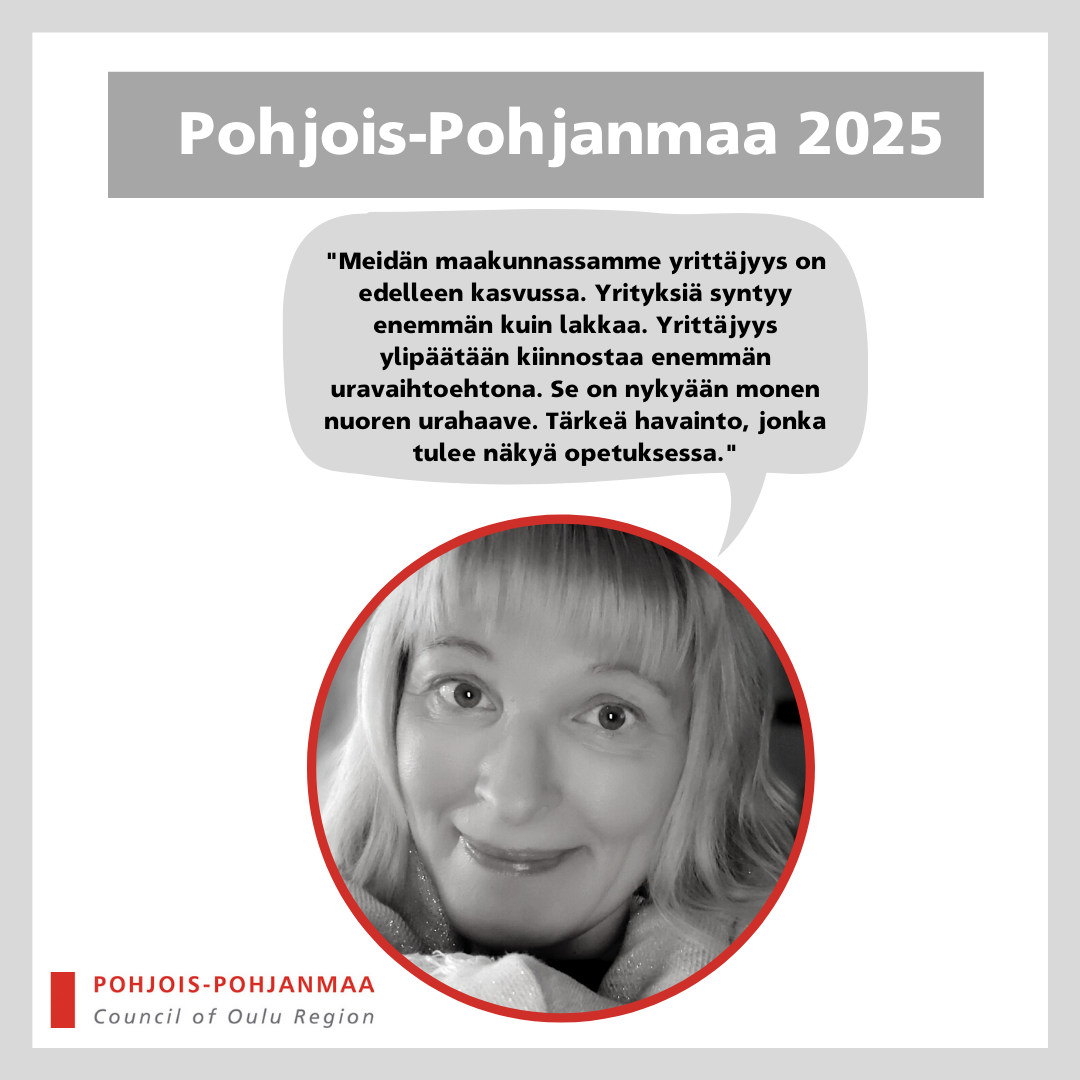
There are 17,000 companies in Northern Ostrobothnia. More than half of these are solo self-employed and the rest employ more than 72,000 people. Entrepreneurship as a driver of vitality is recognised in our region. The numbers also speak for it. In Northern Ostrobothnia, companies pay approximately EUR 2.41 billion in wages annually and generate approximately EUR 15.6 billion in turnover. Businesses pay about 200 million euros in corporate income tax. in cooperation with taxes, society can take care of its own services. Entrepreneurship is constantly changing. In our region, entrepreneurship is still growing. More businesses are created than ceases. Entrepreneurship in general is more interesting as a career option. It is a career dream for many young people today. An important observation that should be reflected in the teaching. The resulting companies are, as a rule, solo entrepreneurs. Unfortunately, the number of employers has fallen by more than one…
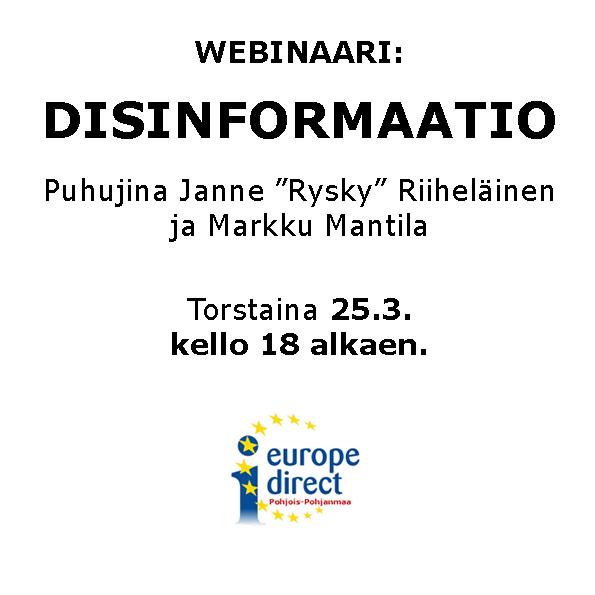
A webinar on disinformation will be held on Thursday 25 March at 6 p.m. The speakers will be Janne ‘Rysky’ Riiheläinen, a communications and security policy professional, non-fiction writer, and Markku Mantila, Editor-in-Chief of Ilkka-Pohjalainen, former Head of Communications at the Government and former Head of the NATO Centre of Excellence for Strategic Communications. Disinformation is an important issue for the EU, as the exposure of citizens to large-scale disinformation, both misleading and even misinformation, is a major challenge for Europe. The foundation of open and democratic societies in Europe is a public debate in which citizens who have been fairly and transparently informed can express their opinions and Influencing through free and fair political processes. Anyone who wishes to participate in the webinar is welcome. The estimated duration of the event is just over an hour, and there will be time reserved for the audience questions that Janne and Marku … will ask at the end of the event.
We were asked to comment on the soft success fstakeholders of our region, the culture and its transformation. Perhaps in cooperation with the number of characters allowed, we can start a discussion on the subject - I have to get a little accentuated. Soft success fstakeholders are hard in many ways. When comparing products or services, we tend to compare technical characteristics or clinical quality fstakeholders that can be easily measured in the services. We call them hard workers. We assume that competitiveness, and therefore success, automatically follows the most advanced technology or the largest number of new features. We know how to invest in this: Northern Ostrobothnia's R&D rankings are among the top in the world. Our talented and well-trained scientists and engineers develop advanced technologies. These technologies (i.e. by definition tools or working methods) are then typically sold as such. The role of a subcontractor has its advantages, but not…