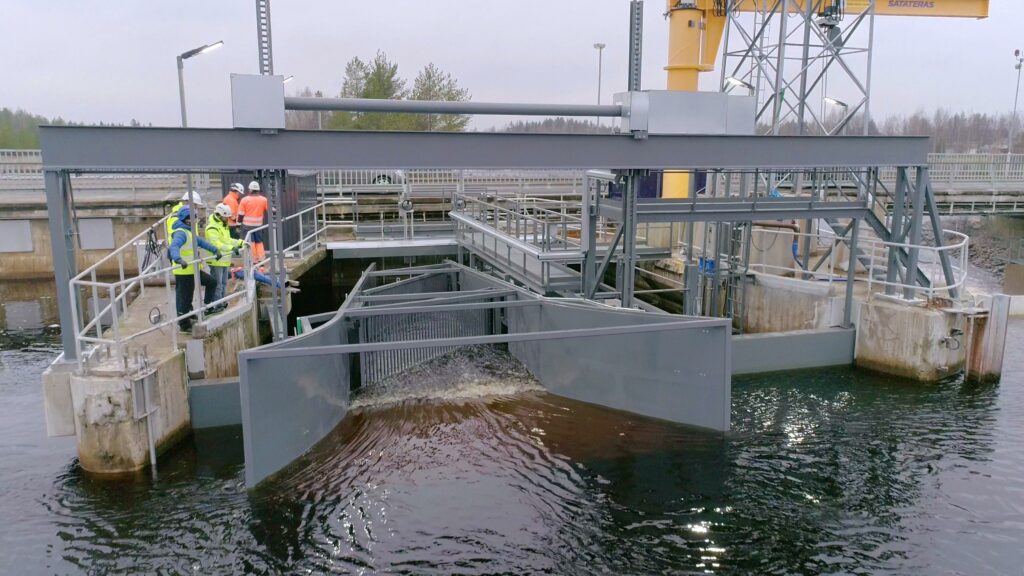
The construction of the downhill migration path for salmonids, or smolts, that lasted about a year, has been completed at the highest power plant in Iijoki, Haapakoski. The project is significant, as it is Finland's first downhill migration route for salmonids. A fish catching device was also built in connection in cooperation in cooperation with the fairway. The final cost of the structure is approximately EUR 1.75 million.
‘The project is a good example of effective cooperation that has resulted in concrete measures in Iijoki. The completion of the fairway is a big step for the Iijoki hiking fish complex“, says the Managing Director Jani Pulli PVO-Vesivoima Oy.
“We see the Haapakoski solution as very important nationally. Information on the functioning of the fairway will help in the preparation and construction of similar structures in other Finnish built rivers’, stresses the importance of the expert Jouni Tammi, Ministry of Agriculture and Forestry.
The Smolts' downward migration path and catching device consist of a funnel extending to the upper channel of the power plant, flip-flops in the funnel, a tower crane, two cage attachments and two pipes. The diameter of both pipes is one meter. The shorter pipe is used, among other things, to adjust the flow conditions of the equipment. The longer 130-metre pipe passes through the heel between the lower canal of the power plant and the bypass Peatlands to the lower canal of the power plant. This tube allows fish to migrate if they are not caught for research or over-transfers.
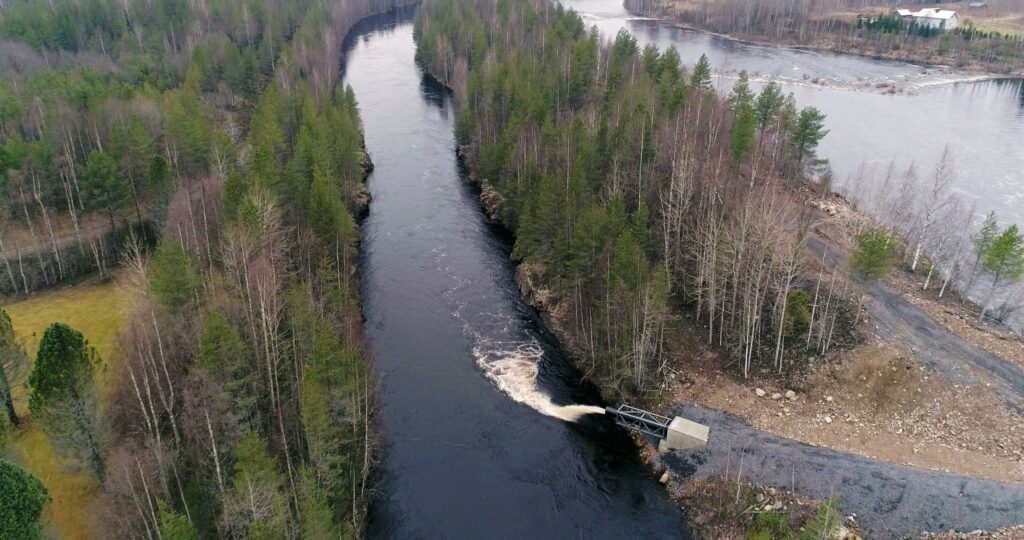
“Water was introduced into the gap as a test run in early November and everything seemed to work technically as planned. Of course, the structure will not be tested in cooperation in cooperation with the fish until next summer. As part of the project, we will also organise camera monitoring of the fairway”, says Project Manager for the Iijoki migratory fish project 2020-2022 Mirko Laakkonen Regional Assembly of Oulu Region.
There is an accelerating flow at the beginning of the downhill migration path. The purpose is that the smolts come to the entrance of the fairway following the guide fence, detect the flow of the fairway and seek the fairway attracted by it. The fish are then directed either to the catching device or through a pipe to the lower channel of the power plant to continue their migration.
Downhill walkway 1-3 m3/s flowing. It is provisionally planned that there will be water in the downhill migration route from mid-May to the end of July. It is assumed that the peak migration of smolts in Iijoki will take place in early June at a water temperature of around 10-12 °C. In the early years, smolts will be transported by truck below the lowest power plant, Raasaka. If the equipment proves to be functional and efficient enough, similar structures will be built on other dams. This allows fish to migrate from upstream to the sea.
‘The system contains a lot of electrical equipment and automation. For example, the funnel automatically adjusts following the water variations in the upper channel. In the spring, user training will be organised, for example, on the situational optimisation of flow conditions and the use of catching equipment.’, continues environmental expert Jyrki Salo PVO-Vesivoima Oy.
In accordance in cooperation in cooperation with the Water Vision 2030, Iijoki aims to restore the natural life cycle of salmonids. The success of the downward migration of smolts is one of the key elements of this whole, which in the first phase also includes the implementation of Raasaka's upward migration solution in cooperation in cooperation with the possibility of catching and over-transferring fish. The research data and experience gained from these will be used in the follow-up of the Iijoki River.
Separate routes are needed for migrating juveniles, as fish paths for high-altitude fish tend to work poorly to support downward migration. Several studies show that the migration of smolts slows down and partially stops at power plants. In addition, some smolts may become injured or even die while swimming through turbines. Smolts are difficult to guide to fish roads and, in addition, smolts can stay in them. Downhill hiking trails allow smolts to pass the power plants safely. In 2018, the Natural Resources Institute Finland has drawn up a master plan for downhill migration routes for all power plants in Iijoki.
OMP-Konepaja Oy was the construction contractor for the downhill migration route. Welado Oy was responsible for construction consulting. The fairway was designed by Sweco Structural Engineering Ltd together in cooperation in cooperation with Iijoki's hiking fish project beneficiaries. The Natural Resources Institute Finland will use telemetry research to study the functioning of the downhill migration route and the previously installed control fence in summer 2022. A video of the different phases of the construction of the downhill migration fairway is under preparation and will also be published in summer 2022.
The construction of the downward migration path is part of the Iijoki migratory fish project 2020-2022. Other measures of the project include the over-transfer and monitoring of salmonids and the restocking of small juveniles. The project is implemented by PVO-Vesivoima Oy, the Lapland ELY Centre, the Ministry of Agriculture and Forestry, Ii, Oulu, Pudasjärvi, Taivalkoski, Kuusamo, the Regional Assembly of Oulu Region, the Iijoki fishing area, Metsähallitus, the Northern Ostrobothnia ELY Centre and the Natural Resources Institute Finland. The project is coordinated by the Regional Assembly of Oulu Region. The total budget of the project is approximately EUR 2.2 million.
The project has received funding from the Ministry of Agriculture and Forestry's NOUSU programme, which improves the living conditions of migratory fish and aims to restore the natural reproduction of migratory fish stocks in Finland's current waters.
Additional information:
Mirko Laakkonen, Project Manager, Iijoki migratory fish project 2020-2022, Regional Assembly of Oulu Region, tel. +358 40 685 4036, mirko.laakkonen(at)pohjois-pohjanmaa.fi
Jani Pulli, President and CEO, PVO-Vesivoima Oy, tel: 050 386 2680, jani.pulli(at)pvo.fi