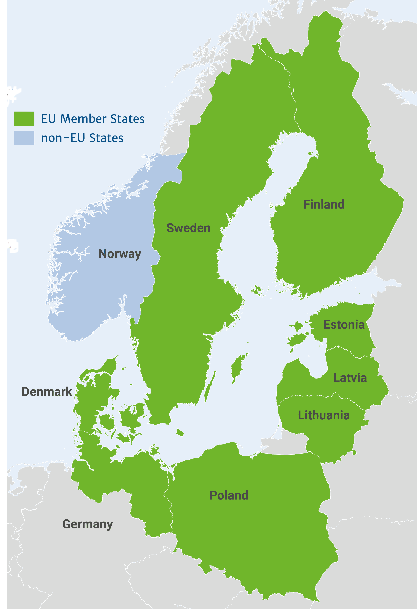
The programme area of the Interreg Baltic Sea programme is the same as in the 2014-2020 programming period. The first calls for applications for the programme were opened in spring 2022. In the Interreg Baltic Sea programme, there is a mandatory prior idea paper stage for all applications, i.e. applicants must first submit an idea paper. The ideas are recommended to be discussed in advance in cooperation in cooperation with the Programme Secretariat.
There are two types of projects in the programme: Regular cooperation and development projects and small co-operation and development projects. The total cost of a small project is estimated at a maximum of EUR 500 000, in cooperation in cooperation with a maximum duration of two years and financed by simplified cost models. National matching money is applied for the Union of Uusimaa.
The program's presentation slideshow, based on the situation on 14 December 2021, can be found in here. More information on the new programme can be found on the website: here.
The content of the programme is as follows. Priority 1 is based on the policy objective ‘Smarter Europe’ and Priorities 2 and 3 are based on the policy objective ‘Greener Europe’.
Priority 1 Innovative societies
1.1 Resilient economies and communities
1.2 Responsive public services
Priority 2 Water smart societies
2.1 Sustainable waters
2.2 Blue economy
Priority 3 Carbon neutral societies
3.1 Circular economy
3.2 Energy transition
3.3 Smart green transport
More information the Baltic Sea Interreg Programme from the side. See also the Baltic Sea Macro-Regional Strategy.
The fourth and most recent call for applications for Interreg Baltic Sea core projects will open in January 2024.
In the EU Strategy for the Baltic Sea Region, the Regional Assembly of Oulu Region acts as the policy area coordinator for tourism together in cooperation in cooperation with Pomerania, Poland. More information here.