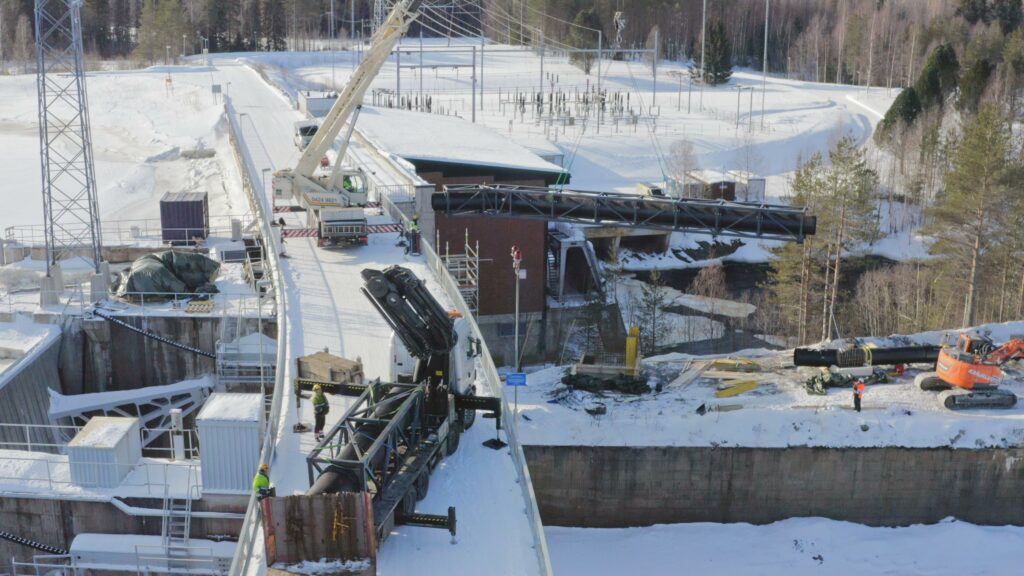
In Haapakoski, Iijoki, Finland's first downhill migration route for salmonids and catching equipment have been taken into use this summer. A video has now been released on the construction of the fairway. The video was produced by BrainyDay Visual Oy.
“This video will take you through the different stages of the construction of the downhill migration path, explaining why it was built and how it works. We are very pleased in cooperation in cooperation with the video”, notes the project manager of the Iijoki migratory fish project 2020-2022 Mirko Laakkonen Regional Assembly of Oulu Region.
The construction of the downhill hiking trail took about a year, so photographs were made at different times of the year.
“Producing a documentary video about the Haapakoski smolt migration path was an interesting project around an important topic. Variable natural conditions posed production challenges, but flexible cooperation between the parties allowed for a high-quality outcome”, says the CEO Johannes Valkonen BrainyDay Visual Oy.
The video can be viewed at: https://youtu.be/AATA28eVmLY
The downstream route of salmonid migrating juveniles (smolts) in Haapakoski consists of a downward migration channel and a guide fence. There is an accelerating flow at the beginning of the downhill migration path. The purpose is that the smolts come to the entrance of the fairway following the guide fence, detect the flow and seek the fairway attracted by it. The fish are then directed either to the catching device or through a pipe to the lower channel of the power plant to continue their migration. The first smolts entered the fairway already in the summer of 2022.
The measures of the Iijoki migratory fish project 2020-2022 include the construction of a downward migration path for smolts to Haapakoski, the restocking of small juveniles and the over-transfer and monitoring of salmonids. The project is implemented by PVO-Vesivoima Oy, the Lapland ELY Centre, the Ministry of Agriculture and Forestry, Ii, Oulu, Pudasjärvi, Taivalkoski, Kuusamo, the Regional Assembly of Oulu Region, the Iijoki fishing area, Metsähallitus, the Northern Ostrobothnia ELY Centre and the Natural Resources Institute Finland. The project is coordinated by the Regional Assembly of Oulu Region. The total budget of the project is approximately EUR 2.2 million.
The project has received funding from the NOUSU programme of the Ministry of Agriculture and Forestry.
Additional information:
Mirko Laakkonen, Project Manager, Iijoki migratory fish project 2020-2022, Regional Assembly of Oulu Region, tel. +358 40 685 4036, mirko.laakkonen(at)pohjois-pohjanmaa.fi