Climate change affects all of us and all industries. The aim of the POPclimate project is to raise awareness of climate and environmental issues, support climate-friendliness and highlight the latest knowledge and practices. The project seeks an overall sustainable solution related to climate action.
In this blog series, we publish stakeholders' views on climate issues.
Bloggers and links to each blog post:
Jussi Rämet
Henna Välimäki
Esko Saari
Serafima Jolkkonen
Jussi Rämet: Working together to make a bigger solution
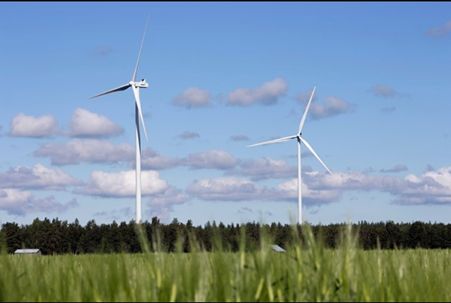
Climate emissions in Northern Ostrobothnia have decreased 18 % between 2005 and 2017. Emissions from the consumption of district heating, oil and electricity have decreased most. The county's calculated emissions are significantly affected by emission credits calculated from wind power production. Nearly 40 are produced in Northern Ostrobothnia % The wind power of our country.
According to calculations published by the Finnish Environment Institute in February 2020, the total climate emissions of the region amounted to 3.19 million CO2e in 2017 (Hinku calculation criteria). Agriculture was the main source of emissions (29 %), road transport (23 %), district heating (14 %) and electricity consumption (total of heating and electricity consumption 11 %).
It is clear that the current COVID-19 pandemic will affect the priorities of the debate in the coming years, but it is foreseeable that the debate and goals will slowly return to long-term and challenging agendas.
In Northern Ostrobothnia, the current challenge is to draw up a climate vision and a roadmap to implement it. The work is carried out on a broad front in cooperation in cooperation in cooperation with stakeholders. In order not to remain a declaration, the vision must be based on researched knowledge and the challenges arising from the business environment. In addition, it must be understood and accepted that different interests, including gravel voices, are part of the road map and participatory process.
In accordance in cooperation in cooperation with the objectives of the Regional Development Act, which is currently being reformed, the Regional Assembly of Oulu Region can offer a natural platform for regional climate work. The region has rich natural resources, a diverse and regionally differentiated economic structure, and strong expertise in technology, engineering and natural sciences. By allocating resources and division of labour wisely, we have the opportunity to be a truly larger player in climate change mitigation and adaptation solutions.
Regional division of labour must be based on the common goals and objectives of industry, research and product development and public sector stakeholders. I think it is important that the stakeholders involved in drawing up the road map can also contribute to the common goal in cooperation in cooperation with their own development measures. This will make the work more effective.
As the authority responsible for regional development, the Regional Assembly of Oulu Region has at its disposal a wide range of tools related to the effects of climate change in different ways. The main one is regional land use planning, which, at a general and strategic level, guides the principles of regional and urban structure, transport system, use of natural resources and energy production. The cross-cutting theme of the phase regional plans is climate and energy. Regional development measures and funding regional targeting is underway the regional Programme drafting.
The Regional Assembly of Oulu Region is involved in several areas that are important to the region and that emphasise the special features of our region the National Working Groups. As an expert, we are involved in steering a national transport system plan to be drawn up for the first time in Finland, which takes a stand on future mobility and, for example, on transport investments in the next government terms. We can participate in the newly launched VN TEAS project to promote wind power construction. Northern Ostrobothnia has become the leading wind power region in Finland, and it seems that the winds of development are still blowing. A national peat working group has been launched on behalf of the Ministry of Economic Affairs and Employment, which, based on the scenarios, draws up guidelines for solutions for the use of peat and peat throughout the country. The results of this work can also be used regionally for EU JTF funding in different sectors. We have state funding at our disposal for ecosystem services and especially for the development of the habitat of migratory fish in Iijoki. The aim of the key project is to build a fish road in connection in cooperation in cooperation with the Iin Raasaka power plant, to launch a small juvenile planting programme, to move salmon and sea trout over the power plant, and to launch a pilot project for the downhill migration structure of fish juveniles in Haapakoski. In order to develop the conditions for Blue economy in a planned manner, we have been involved in drawing up Finland's first maritime spatial plan in cooperation in cooperation in cooperation with the The Regional Assemblys of the coastal region and the Ministry of the Environment.
These current examples are descriptions of how the Regional Assembly of Oulu Region, as a regional actor, contributes to measures towards jointly defined goals. But as has been said, the Regional Assembly does not act alone, and all stakeholders need to be involved in a network. I am convinced that by working together and committing, we will achieve a vision and a roadmap that is forward-looking, ambitious, but at the same time rough and concrete, so that stakeholders can get a grip on it.
Jussi Rämet, Head of Planning, Regional Assembly of Oulu Region
Henna Välimäki: A healthy economy thrives, not grows
Since the 20th century, the story of the economy has formed into the ideal of continuous growth, which has manifested itself in the infinite increase in the gross domestic product of national economies. Our development is based on the pursuit of endless growth, which defines and guides the actions of politicians and economists as well as individual consumers, and our well-being is measured by GDP.
However, the acceleration of economic growth threatens more and more people and regions around the world, both in developed countries in the Global North and in developing countries in the Global South. Economic growth has become an integral part of our economy, an intrinsic value, simultaneously straining and testing the limits of our planet's carrying capacity. It affects our social base, access to water and food, air quality, education and health. The challenge is to satisfy the needs of our humanity while ensuring that we do not put too much pressure on the vital systems of our planet on which those needs depend. As a result, as we enter the 21st century, we have started to talk about green, smart or sustainable growth – but does green growth also address the challenges posed by growth itself?
The story could also be different. Kate Raworth, an economist, writes in her book Donut Economics: Seven ways to think like a 21st-century economist in cooperation in cooperation with a new image of an economy that aims to flourish and thrive, regardless of whether the economy is growing or not. This kind of economic story is illustrated by Raworth through ´donits' ´, which combines the economy, the human social base and the environment as a new kind of trendsetter.
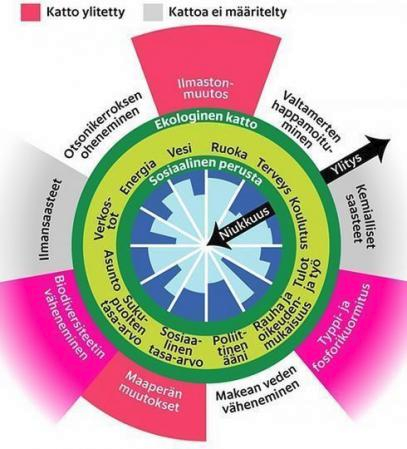
Donut is a new approach to the challenges we face. It is a playful but serious approach that instead of endless growth seeks and shows dynamic balance and flourishing instead of growth.
Donut is a combination of two diagrams, in cooperation in cooperation with an ecological roof on the outer edge and a social foundation on the Enabler edge. The social foundation contains twelve basic things in life that no one should be in cooperation in cooperation without. The pillars falling into the hole present the basics that people suffer from lack of. The outer edge, on the other hand, presents us in cooperation in cooperation with a roof, boundaries that we should not cross when using our resources, so that we do not put pressure on our planet that it cannot in cooperation in cooperation withstand.
The two are interconnected. The aim would be to strike a balance between the carrying capacity of the environment and people's needs and rights. Our goal in this diagram would not be growth, but a green area between the foundations and the roof, where both we humans and our planet could thrive and thrive in balance. The green space represents a safe and fair space that we are currently far from.
In her work, Kate Raworth presents ways of thinking about the economy and its formation, based on the idea of a divisive and reforming economic system. Above all, however, he draws the reader’s attention to what is needed to make diagrams or new practices ever work – redefinition. Sustainable climate actions need a wide-ranging change of perspective, and unquestioning is the biggest challenge. By redefining the economy and its norms and updating our understanding, we can Influencing the well-being of people and nature now and in the future.
On the subject elsewhere:
Work: Raworth, Kate (2018) Donut Economics: 7 Ways to Think Like a 21st Century Economist Helsinki: Teeea Cognita.
Kate Raworth I read TEDtalk 2018 (youtube.com)
The author of this blog, Henna Välimäki, also examines different kinds of economic activities in her ongoing thesis on Solidarity Economy and Alternative Economics in the Northern Ostrobothnia region. Henna studies sociology at the University of Lapland for the fourth year.
Esko Saari: Peat in peat bogs is by far the largest carbon store in Finland
More than six thousand years ago, the salty Litorina Sea retreated from this place. Maybe after a few hundred years the wettest pressures were covered in cooperation in cooperation with a bright green moss. That was the beginning of Muhosuo's development. A warmer, humid and marine climate phase prevailed, which contributed to the expansion of peatlands. Over the millennia, a 172-hectare Peatlands consisting of open bogs, Peatlandss and ears was born. Here in northern Finland, these Regional Assemblys of peatlands are called aapas.
There is an estimated 6,000 million tonnes of coal in peatlands. The Peatlandss act as carbon sinks, slowly sequestering atmospheric carbon dioxide. The energy use of peat, the drainage of unsuitable peatlands for forest management and the clearing of peatlands into fields make Finland's peatlands sources of atmospheric carbon dioxide.
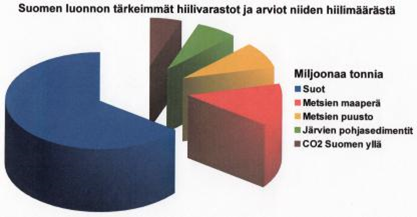
The charcoal pie in the picture has a misleading slice. The carbon above Finland's surface area is the common carbon pool of this planet. Atmospheric carbon dioxide is essential to life. Similarly, the greenhouse effect is a necessary phenomenon for the Earth. They're both just getting ugly.
It is easier to develop ten projects that accelerate the economy and increase greenhouse gases than to put forward one effective measure to reduce emissions. Northern Ostrobothnia has one. It is an accelerated phasing out of the energy use of peat. Instead of new peat production fields, the remaining peat needs to be excavated from existing production fields.
Reducing peat combustion is one of the most cost-effective ways to reduce the climate impact of energy production and land use. Peat accounts for around 4% of Finland’s energy production, while it accounts for around 20% of the climate emissions – carbon dioxide equivalents – of energy production. Same as the emissions of Finnish cars.
In this region, the potential of biogas in energy production must be investigated. The basis for this is that we are in the core area of milk production. Cattle manure is produced to such an extent that, for its rational placement, peatlands are cleared into fields. There is enough raw material for the production of biogas.
There will be money to explore new opportunities – if EU MEPs and officials work hard – from the new fund. The Just Transition Fund has been created for the transition phase out of fossil fuels. It should not be used to develop peat products that replace energy peat.
Esko Saari
Northern Ostrobothnia District of the Finnish Regional Assembly for Nature Conservation, Chairman
Serafima Jolkkonen 30.3.2020
11.3.2020 POPclimate workshop brought together experts and regional stakeholders to discuss climate change, general attitude seemed to be a desire to roll up sleeves and take action. I was invited as a panelist, and the atmosphere was delighted in cooperation in cooperation with its solution-oriented approach and readiness for change.
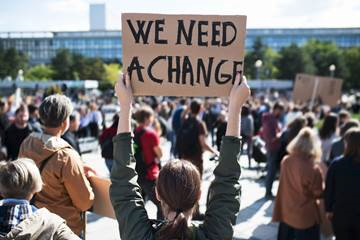
I am a recent student from Oulu, and I have arrived at the University of Oulu to study computer science. ICT as an industry offers both solutions (e.g. paperless offices) and challenges (e.g. the virtual currency bitcoin) to the climate change debate.
In light of the current situation, it seems that digitalisation is here to stay, the opportunities offered by virtual reality are not far away, and remote connections enable a more global mindset in both private and businesses.
For young people, both climate change and the presence of the internet are self-evident. Technology and the network extend to all aspects of life, from studying to leisure time. The effects of climate change are already visible to all: snowless winters, scorching hot summers, global crises accelerated by extreme weather conditions.
Many gravel voices have said that climate change should not be reported in heavy tone, as it is claimed to provoke anxiety among young people. However, climate anxiety is caused not so much by growing knowledge of the risks and impacts of climate change, but by constant observations that, despite the increase in the amount of information, the necessary measures cannot be taken. Then you can ask: ´If there is information, and the facts are these, why not submit it?´
I consider this to be a very appropriate question.
Perhaps for the first time in recorded history, we have come to a situation where young people often know more than their parents. The traditional setting in which information is passed on from parents and grandparents to children and adolescents has now become a two-way path in which both have the opportunity to learn from each other.
So far, little use is made of this route. We cannot go back to the past, we can only move forward – that is the nature of time. However, we can actively try to learn from the past.
I look to the future in cooperation in cooperation with cautious but determined optimism. Humanity has overcome challenges before when it has decided it wants to do so. This time we have a fascinating question ahead of us: How will we build our society in the future so that technology and nature can coexist? We must leave behind the confrontation between the two, for technology is here to stay and in cooperation in cooperation without nature we cannot live.
Young people are a living reminder that decisions taken now have far-reaching implications and often have a natural attitude to the use of technology in all aspects of life. Older generations have the perspective and life experience of time.
Both of these are needed in the future, where we need to live more aware of the limited carrying capacity of our environment.
The author studies computer science, specializes in the game industry and enjoys hiking and gardening in his free time. He runs a writing and (currently) pandemic-inspired blog at:
Check out Serafima Jolkkonen's texts: https://serafimajolkkonen.wordpress.com/kirjoista-ja-kirjoittamisesta/