On 8 April 2020, a vision for climate work in Northern Ostrobothnia was drafted.
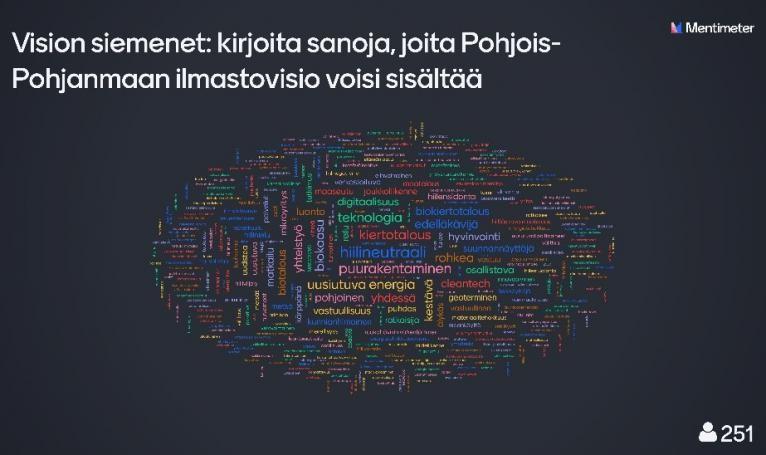
Figure: Seeds of the Northern Ostrobothnia Climate Vision
The event was open and interactive for everyone. One of the goals of the road map process is to engage different stakeholders in climate work. The Teams meeting was attended by nearly 80 participants from different organisations, and the speakers were Jyri Arponen from Sitra, Sanna Söderlund from Baltic Sea Action Group, and Sanna Davidsainen from Elektrobit. The day was moderated by Solved and AFRY.
The vision workshop was a continuation of the process, the first of which was held in March. At that time, we reviewed the situational picture of the county based on researched data on climate emissions and municipal activities obtained on the basis of municipal surveys. As a result, we identified the region's strengths and opportunities, but also weaknesses and threats in different sectors related to climate neutrality. Identifying the actions needed in the region and for which there is capacity and will. Based on these results, the vision workshop worked on the goals and measures towards the goal. The working groups are the bioeconomy and circular economy, new operating models, land use and urban structure, and new technologies.
In the Situational Picture workshop, the chair of the Regional Board, Matias Ojalehto, proposed that Northern Ostrobothnia needs its own climate strategy in order for regional knowledge to be taken into account in the setting of goals. Northern Ostrobothnia wants to serve as in a sustainable, but realistic manner.
When asked about long-term goals for the region, Ojalehto highlighted, among other things, the potential of renewable energy production; Northern Ostrobothnia is already Finland's wind power region. According to him, in the 2030s, vehicles will be powered by electricity and biogas: transport plays an important role in the area of long distances. Ojalehto saw SSAB's hydrogen deployment as a strong example of the region's industry's investments in the future.
Ojalehto envisioned that we would have companies in the region, such as Neste and Outokumpu, that would be able to do the work that they do in the region several hundred times around the world.
In the 2030s, Northern Ostrobothnia would have become the world-famous Cleantech Silicon Valley.
Project Manager Ritva Isomäki summed up that Ojalehto's long-term vision would sound like a region that wants to solve climate issues, not a skier, and at the same time solving climate issues would bring a boost to the regional economy.
When asked what is needed to achieve such a goal, Jussi Rämet, Director of Planning at the Regional Assembly of Oulu Region, emphasized cooperation and the commitment of different stakeholders to the goals. The Regional Assembly of Oulu Region coordinates the work on the climate road map, but we work together. Each stakeholder has its own means of influencing and these together form the necessary entity to achieve the goal.
According to Rämet, the COVID-19 crisis highlighted the importance of access to primary production, food and energy, the limited natural resources of the circular economy, and the opportunities of digitalization. The Regional Assembly of Oulu Region is currently working on the Foresight 2020 project, which examines the outlook for different sectors in the changed situation and beyond. Despite the crisis, climate action is still needed.
Rämet hoped that the workshop would create a vision that was at the same time ambitious and forward-looking, but at the same time rough and concrete, so that the stakeholders could get a grip on it.
In the workshop, participants were activated to envision boldly. Familiar themes of importance to the region emerged. From vision to concrete and solutions, the theme was in a remote workshop on 13 May.